
Why Your Car's Infotainment Screen Is So 2019 (And You Can Totally Ditch It in 2026) 😱📱
Your smartphone makes car infotainment systems redundant, offering faster navigation, media, and updates at no extra cost.
Honestly, the moment I climbed into a friend’s brand‑new 2026 SUV last week and saw the familiar 15‑inch slab of glass dominating the dashboard, my brain went full dial‑up tone. It’s 2026, and we’re still pretending that a giant, laggy, manufacturer‑skinned tablet bolted into a car is the pinnacle of in‑vehicle tech? Having an all‑singing, all‑dancing infotainment system in your car today is like handing a paper map to a pilot who already has a supersonic jet’s navigation suite – nostalgic at best, but utterly redundant.
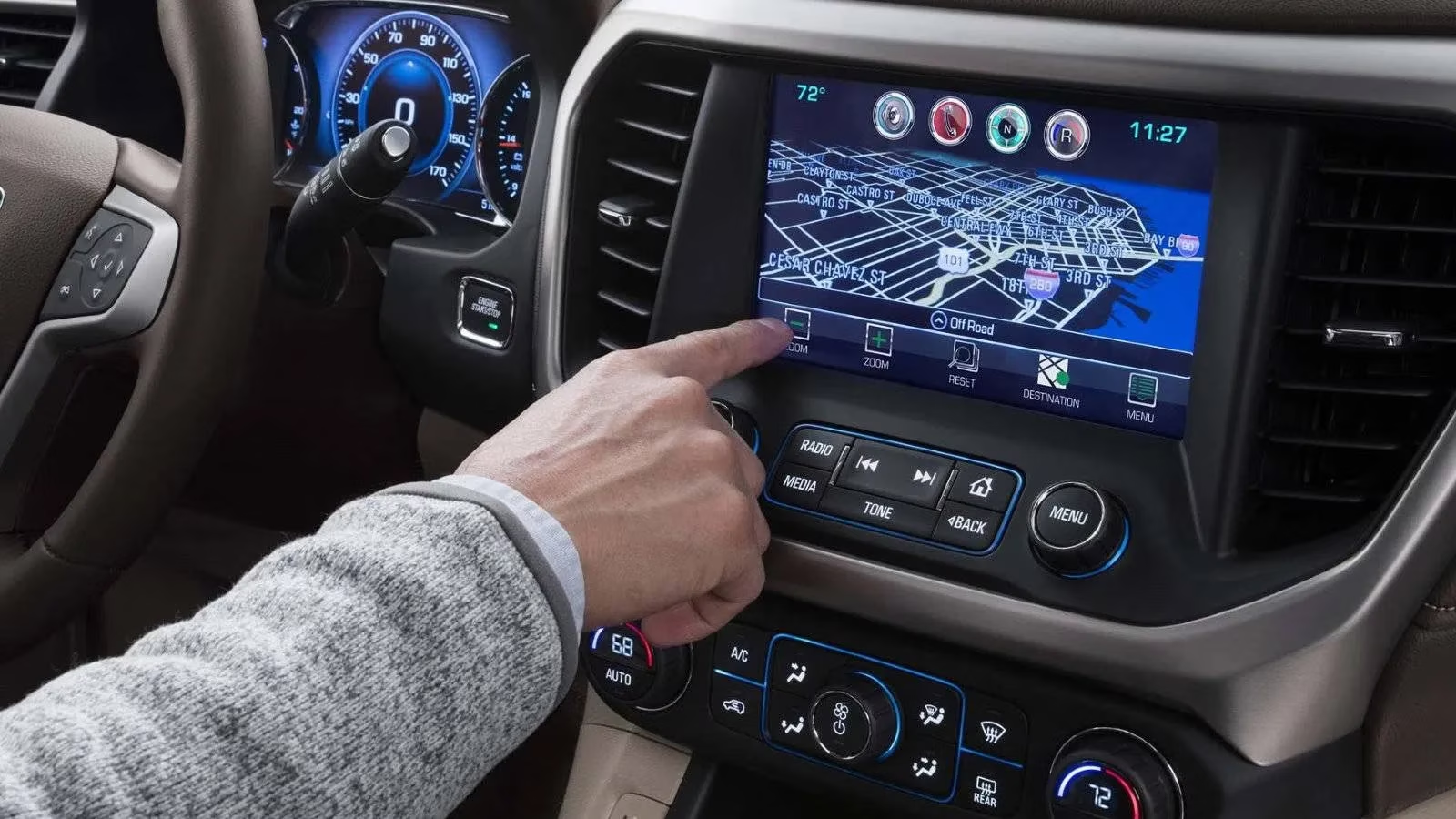
Let’s rewind for a second. Car entertainment started innocently enough: radios, cassette decks, CD changers, then basic LCDs for MP3 players. Fast‑forward to now, and pretty much every vehicle comes with a display that makes you wonder if you accidentally drove an iPad into your console. It streams music, pulls up live traffic, checks the weather, and sometimes even orders your overpriced latte. But here’s the wake‑up call – the phone in your pocket already does all of that, usually faster and with an interface you actually like. This is the automotive equivalent of storing your files on floppy disks when you have iCloud; the extra layer feels not just unnecessary, but borderline silly.
📲 The Supercomputer You Already Carry
CarPlay and Android Auto flipped the script years ago, and by 2026 they’ve become so seamless that the underlying car OS barely matters. All I need is a wireless connection (or even just a $20 Bluetooth adapter in an older car) and my phone pours its soul onto any screen. Navigation? Waze or Apple Maps with real‑time crowd‑sourced alerts. Podcasts? Pocket Casts remembers exactly where I left off. Music? Lossless audio streamed from my own library or spatial audio from Tidal. The car’s native apps? I haven’t opened them since the day I signed the lease. It’s like keeping a monochrome PDA next to your foldable smartphone – charming in a retro way, but absolutely pointless.
💸 The Hidden Costs No One Talks About
If carmakers just gave up on in‑house infotainment, a few magical things would happen overnight:
-
Cheaper cars – No more expensive pseudo‑tablet hardware, no licence fees for proprietary maps or voice assistants. That’s easily a few hundred bucks off the MSRP.
-
Zero stereo theft – Why would anyone break a window for a device that’s not even there?
-
Dashboard zen – An uninterrupted, smooth dash without an 11‑inch black rectangle sucking the soul out of the design. Instead, you’d have a sleek, integrated MagSafe‑style holder that charges your phone and instantly becomes the brains of the car the moment it snaps in.
Think about it: almost nobody who can afford a car doesn’t already own a smartphone. So why are we paying twice for the same functionality, one of which ages like milk while the other gets updated every year?
🏎️ Lotus Saw the Light (Sort of)
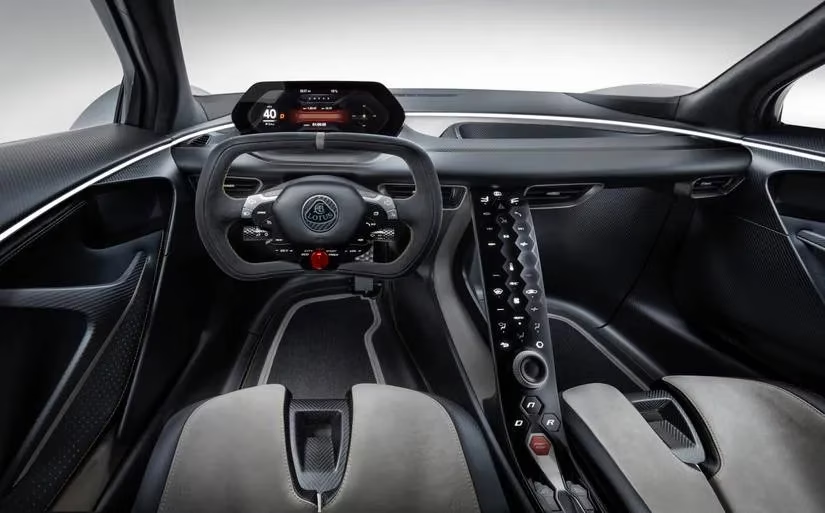
The only production car that genuinely said “nah” to the infotainment bloat is the Lotus Evija hypercar. When Lotus revealed the Evija, its cabin made jaws drop not because of a massive curved screen, but because of the glaring absence of one. They stripped away the centre stack clutter entirely and assumed you’d bring your own device.
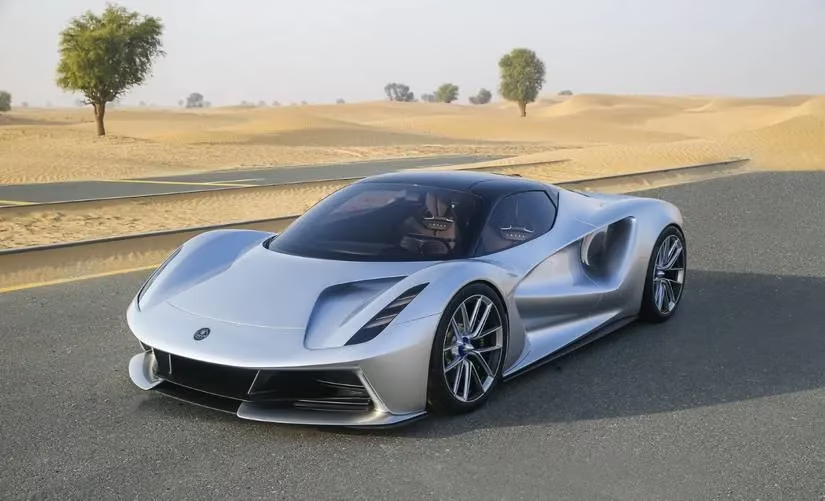
The irony? The Evija costs millions, making it about as accessible as a personal space elevator. And even Lotus forgot the last step: it didn’t include a built‑in phone holder. You still need to awkwardly prop your phone against the windshield or buy a third‑party mount that ruins the aesthetic. Still, the intent was revolutionary. It proved that a dash cleansed of screens can look sculptural, timeless, and almost calming – a sensation I didn’t realize I missed until I saw it.
🔧 DIYers Have Been Doing This for Years
Walk through any car enthusiast forum and you’ll find entire threads dedicated to ripping out sluggish factory head units and replacing them with old phones or tablets running custom launchers. These mavericks have figured out that a 4‑year‑old Pixel or a retired iPad mini is infinitely more capable than a 2026 model‑year OEM system that still freezes when you ask for a simple POI search. If shade‑tree mechanics can pull this off in a weekend, why are multi‑billion‑dollar automakers still pretending that their bespoke software is a selling point?
📡 Over‑the‑Air Updates? Please.
Some defenders will shout, “But OTA updates! The car can fix itself!” Sure, a standalone modem for firmware updates is handy for battery management or brake tuning, but that data can be displayed right where it belongs – the instrument cluster. Our phones are already OTA kings; they get security patches monthly and OS overhauls yearly. Locking navigation and media into the car’s ageing hardware is like insisting that your smart fridge double as your primary email client. It’s forced convergence at its worst – a solution in search of a problem.
🔒 The Privacy Angle
What nobody talks about enough: modern connected infotainment systems are data‑hoarding machines. They track your location, your contacts, your call logs, and even your voice commands, all feeding a profile that the manufacturer can monetise or “share with trusted partners.” By contrast, my phone runs an encrypted OS with granular permission controls that I actually understand. Ditching the car’s brain means I’m no longer broadcasting my daily latte route to a dozen corporate servers just to hear a Spotify playlist. In an era where digital privacy is the new gold, that’s a massive, under‑appreciated win.
🪦 The Real Question Isn’t “Why Drop It?” but “Why Keep It?”
We’ve normalized the idea that a car must have a tablet stuck to the dash, the same way we once believed every living room needed a bulky CRT television. But 2026 is the year of modularity and personalisation. Automakers are slowly inching toward removable displays – BMW’s next‑gen iDrive is rumoured to support a dockable personal device mode, and several Chinese EV startups already ship their cars with a blank panel where you magnetically attach your own screen. The transition is happening, just slower than my patience can handle.
I don’t want a car that tries to outsmart my phone; I want a car that humbly admits my phone is smarter, and elegantly gets out of the way. Give me a sturdy, fast‑charging cradle, seamless wireless projection, and a software‑free dash that lets the phone shape‑shift into whatever interface I need – navigation, performance gauges, or a giant “now playing” widget. It’s not only simpler, cheaper, and future‑proof; it’s also the only honest path forward in a world where the device in my hand already holds the entire universe.
Next time you watch a car commercial boasting about “all‑new interface” and “app ecosystem,” remember: they’re selling you a floppy disk in the cloud age. And once you see the beauty of the phone‑first philosophy, you’ll never unsee it. 🚗💨
Leave a Comment