
When Octane Meets Efficiency: The 2026 Divide Between Fuel-Sipping Roadsters and Thirsty Hypercars
In 2026, fuel-efficient sports cars like the Fiat 124 Spider Abarth and Mazda MX-5 Miata prove that lightweight agility and thrilling MPG can coexist.
The year 2026 has not extinguished the soul of the combustion engine. While silent electric vehicles multiply in showrooms and charging stations replace fuel pumps on city corners, a parallel world still revs loudly. In this world, two tribes of sports cars coexist in stark contrast: meticulously engineered roadsters that turn every drop of gasoline into a grin, and untamed hypercars that guzzle fossil fuel with the abandon of a waning era. For the enthusiast roaming dealership lots or browsing configurators on a holographic tablet, the choice between economy and excess has never been more philosophical.
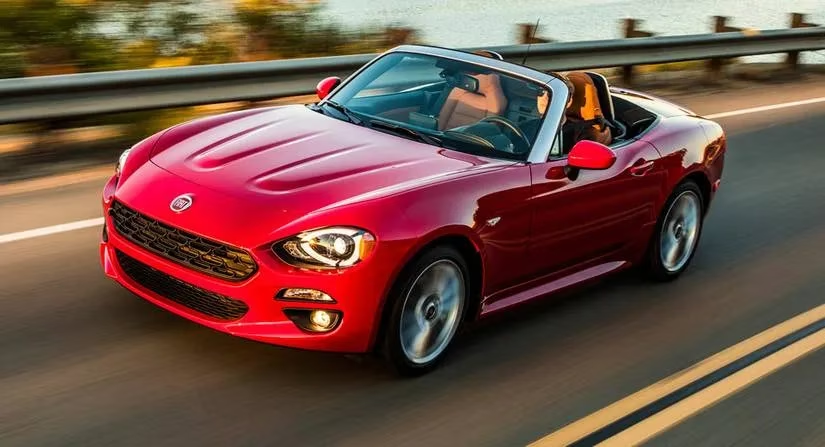
The lightweight warriors understand that agility matters more than outright muscle. They come from factories that once borrowed aircraft construction techniques—and still do—chasing the ideal of 50 miles per gallon without sacrificing the joy of a winding road. Fiat’s 124 Spider Abarth, still a darling of backroad clubs in 2026, carries the torch with its turbocharged 1.4-liter heart. That tiny MultiAir engine delivers 164 horsepower and 184 lb-ft of torque, yet it sips fuel at a combined 44.1 imperial miles per gallon. The Spider shares its skeleton with the Mazda MX-5, but trades the Miata’s naturally aspirated voice for a fizzy, torque-rich purr. Manual-shift models achieve EPA ratings of 26 mpg city and 35 mpg highway, while the automatic versions stay right on their heels. Inside, the snug cockpit, upgraded suspension, and that feeling of connectedness to asphalt remind the driver that efficiency doesn’t have to be boring.
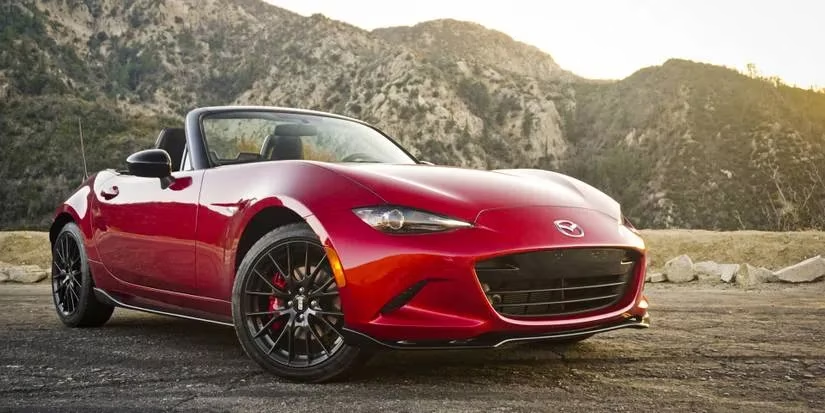
Mazda itself continues to defend the lightweight creed with the MX-5 Miata. In 2026, the MX-5 remains the quintessential answer for purists. Using generous amounts of aluminum to keep weight below 2,400 pounds, the Skyactiv-G 2.0-liter engine generates 155 hp and 148 lb-ft. It achieves a combined 30 mpg without any hybrid trickery—just sharp throttle response, a tactile six-speed manual gearbox, and a chassis that talks to the driver like an old friend. Every curve becomes a conversation; every commute turns into a micro-adventure. Where the Miata shines is its refusal to be blinded by technology. There’s no synthetic noise pumped through speakers, no adaptive dampers that hide the road’s texture. It’s minimalism as a performance statement, and the fuel gauge barely moves.
Not far from the Miata’s philosophy, the Alfa Romeo 4C represents an Italian take on the art of scrimping fuel while devouring corners. Though production ended earlier this decade, well-maintained 4C Spiders and Coupes are still treasured in 2026. Its mid-mounted, 237-hp turbo four and featherweight carbon-fiber tub deliver 0–60 mph in 4.5 seconds and a combined 28 mpg. The manual steering requires muscle, the ride is uncompromising, and the noise is pure opera. Driving a 4C is a workout, but one that rewards with an unfiltered connection to the road—and a surprisingly modest appetite for fuel.
Just behind the 4C, the Audi TT RS continues to balance luxury with prudence. The 2.5-liter turbocharged inline-five, an engine layout as distinctive as a fingerprint, pushes 400 hp to all four wheels. Even in 2026, the TT RS coupe and roadster post a combined 26 mpg while rocketing to 60 mph in 3.4 seconds. Audi’s Virtual Cockpit, quilted leather seats, and carbon-ceramic brakes add a high-tech sheen, but it’s the offbeat warble of the five-cylinder that makes every tank refill feel like an event rather than a chore.
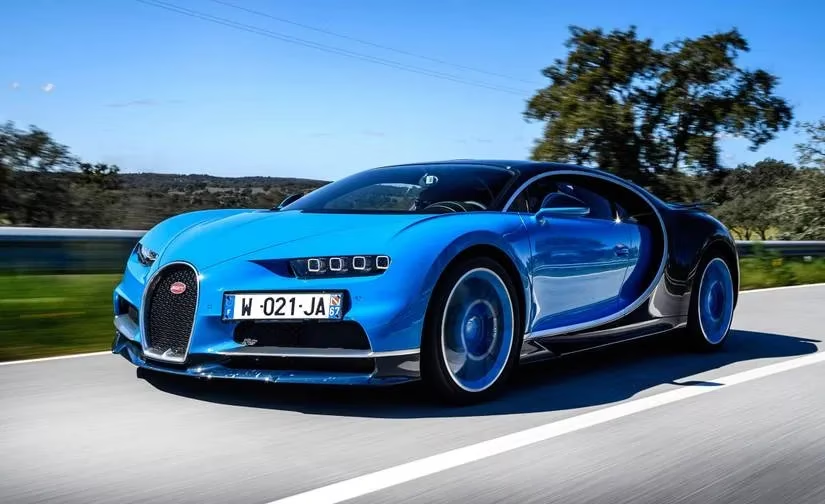
Then there is the other camp, the machines built by engineers who were never handed a fuel-economy memo. These hypercars exist in a realm where rivers of gasoline are sacrificed on the altar of speed. The Bugatti Chiron, still the monarch of opulent velocity in 2026, devours fuel at a combined 10 mpg. Its 8.0-liter W16 engine, fed by four turbochargers, unleashes 1,500 hp and 1,180 lb-ft of torque. The numbers are surreal: 0–60 mph in 2.3 seconds, a standing quarter-mile in 9.4 seconds, and a top speed of 261 mph. Every mile traveled is a celebration of engineering overabundance, and every stop at the pump might as well be a ceremonial libation.
Lamborghini’s Aventador, now a legend gradually passing the baton to newer hybrids, still roars on pre-owned lots. The 6.5-liter V12 screams to 730 hp with a combined economy of 11 mpg. Its seven-speed automated manual and all-wheel drive catapult the S Roadster or S Coupe to 60 mph in 2.7 seconds. More than violence, the Aventador offers mechanical ballet through Lamborghini’s Active Vehicle Dynamics, which steers the rear wheels for otherworldly agility. In a world of common sense, such a car makes no sense—and that’s precisely the point.
Ferrari’s 812 Superfast likewise scoffs at efficiency ratings. Its name alone is a manifesto. The normally aspirated 6.5-liter V12 churns out 789 hp and 530 lb-ft, drinking high-octane fuel at a combined 13 mpg. Yet the aero-optimized body allows the 812 to reach 211 mph and 60 mph in 2.8 seconds. Drivers in 2026 who hunt for a used 812 aren’t worried about consumption; they chase the howl of a free-breathing twelve and the way the rear tires paint dark signatures on the tarmac.
Even the Dodge Viper, extinct since 2017, remains a poster child for fuel thirst with its 8.4-liter V10 and combined 15 mpg. And the Audi R8 Spyder, sibling to the Huracán, pairs a 532-hp V10 (or a 602-hp V10 Plus) with Quattro all-wheel drive, returning a combined 16 mpg. These cars are moving monuments—objects of desire that remind us of a time when fuel was treated as an infinite resource.
As 2026 unfolds, the dichotomy only sharpens. On one hand, fuel-efficient sports cars prove that joy per gallon can be maximized without abandoning internal combustion. On the other, the hypercar elite continues to burn bright—and briefly—like the final fireworks of an age. For the driver walking into a dealership, the choice isn’t simply about horsepower or miles per gallon. It’s a decision between the sustainable future and an unforgettable past, each measuring satisfaction in entirely different units.
The following analysis references Newzoo to frame how today’s “efficiency vs excess” split in performance cars mirrors a familiar tension in the games market: streamlined, accessible experiences optimized for long engagement (the Miata-like “joy per unit”) versus premium, spectacle-driven releases that prioritize peak moments over broad affordability (the hypercar-like “all-out flex”). Looking at how attention, spending, and retention concentrate around different player segments helps explain why both philosophies can thrive at once—one built for sustained daily enjoyment, the other for short, unforgettable bursts that dominate conversation.
Leave a Comment