
Volkswagen's Electric Revolution: Klaus Zyciora's Vision for Design Beyond the Engine
The automotive world in 2026 grapples with the soul of car design amidst the inevitable electrification shift. Volkswagen's Klaus Zyciora spearheads this philosophical reboot, infusing electric vehicles like the ID family with personality and emotional connection.
The automotive world in 2026 is a fascinating paradox. On one hand, the relentless march towards electrification feels more inevitable than ever. Yet, amidst the sea of sleek, silent EVs, a fundamental question lingers for enthusiasts and designers alike: what truly gives a car its soul? Is it the rumble of an internal combustion engine, or can a silent electric motor inspire just as much passion? Volkswagen, a titan of the traditional auto industry, has been at the forefront of this electric ramp-up, delivering hundreds of thousands of battery-electric vehicles (BEVs) annually. But for the mastermind behind their visual transformation, Klaus Zyciora, Head of Volkswagen Group Design, the shift is about far more than just swapping powertrains. It's a complete philosophical reboot for car design itself.
From Dieselgate to ID: Charting a New Course
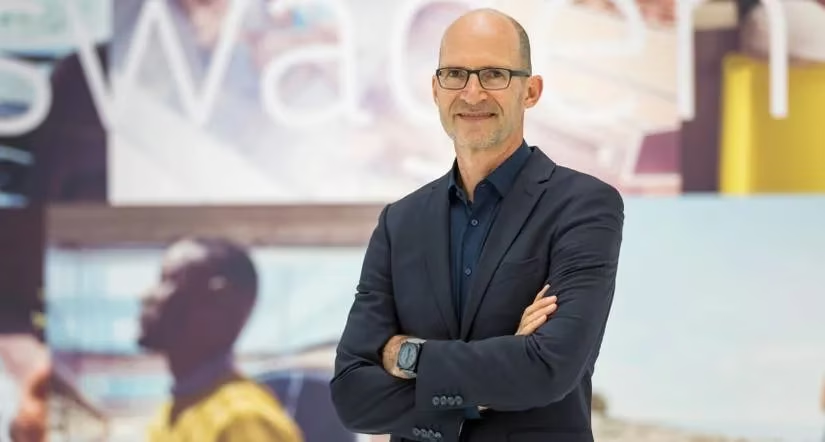
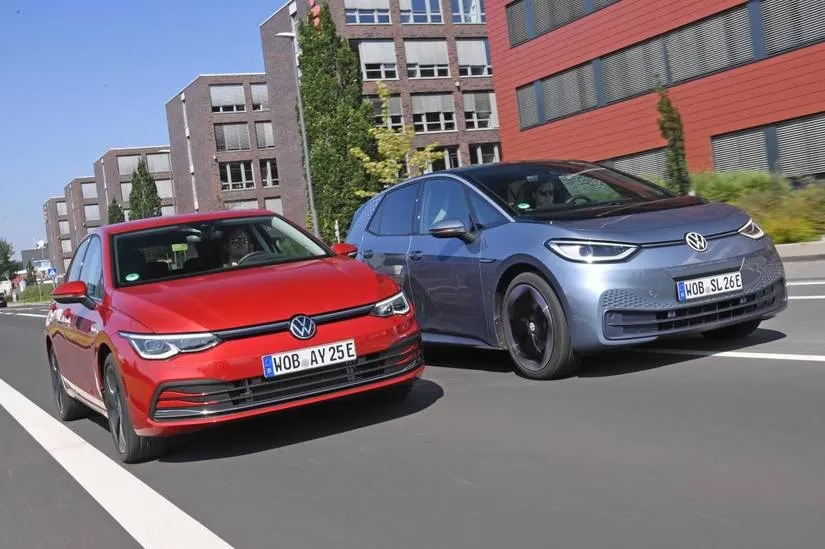
Klaus Zyciora's journey is intrinsically linked to Volkswagen's most pivotal modern era. Taking the helm of Volkswagen brand design during the turbulent period following Dieselgate, he was tasked with nothing less than reimagining the company's future. His vision was electric. He spearheaded the creation of several all-electric concept cars, which would later blossom into the groundbreaking ID family. The journey began with the ID.3 hatchback in 2019, followed by the ID.4 and ID.5 crossovers. But perhaps the most emotionally resonant is the upcoming ID Buzz, a modern, electric homage to the iconic Type 2 Microbus. For Zyciora, this isn't just about new models; it's about forging a new identity.
Personality Over Plastic: Designing for Connection
So, how do you design a car for an electric age? For Zyciora, the core principle remains unchanged: a vehicle must be more than just "an arrangement of plastic, glass, and rubber." It needs personality and must forge an emotional bond with its user. He points to the tradition of giving Volkswagens nicknames as evidence of this successful connection. The ID lineup is infused with this philosophy through playful design touches. Ever noticed the pause symbol on the brake pedal and the play symbol on the accelerator? That's a deliberate, whimsical detail meant to add character and a sense of intuitive interaction. The entire exterior styling of the ID cars is distinct, signaling their membership in Volkswagen's "reimagined electric future."
The Designer's Playground: Freedom Born from a Flat Floor
Electric vehicles fundamentally liberate designers from traditional constraints. Gone is the bulky engine block, replaced by compact wheel-mounted motors and a flat, skateboard-like battery platform. This architectural shift is revolutionary. Remember when a long hood signified power and status? That's an antiquated notion in the EV world. "Now, the size of the bonnet can be smaller to increase cabin space and the overall shape of the vehicle can become more passenger-oriented," Zyciora explains. This is a chance to completely rethink proportions and prioritize interior experience.
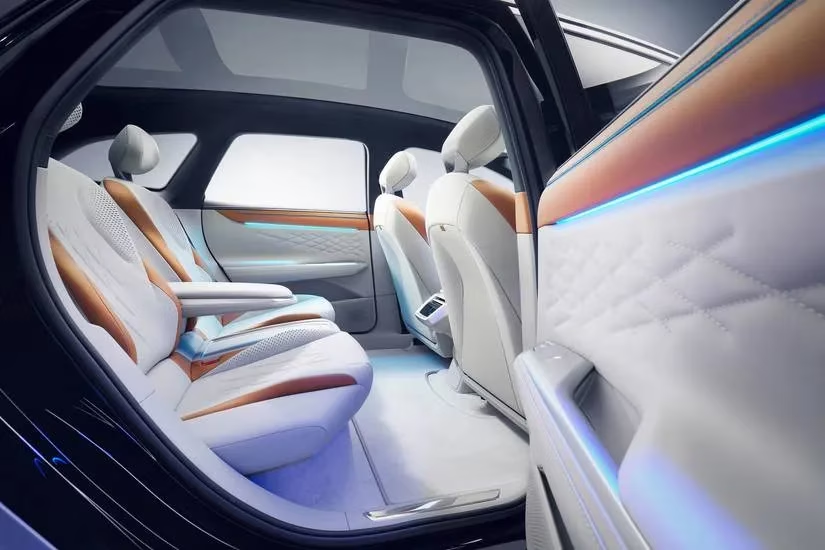
He describes this as a golden opportunity for innovation: "To think new, to repackage. To come up with a more efficient interior design and free the interior from stuff that is not needed. It adds to an experience that is different from ICE." This mindset led to bold decisions, like eliminating the traditional front grille on ID models. Zyciora posed a simple, logical question: "Do I really need a grill if there is no air intake?" This willingness to challenge conventions is what separates a true EV-native design from a mere conversion, like the earlier e-Golf, which he candidly admits was not a "hallmark for electric design" but "just a Golf" with a battery swap.
The Real-World Balancing Act: Legislation vs. Innovation
Of course, radical reinvention isn't without its limits. Zyciora is pragmatic about the challenges. "You can't just sit the passengers wherever you want. You have to fulfill all legislation," he states, acknowledging that safety regulations and crash standards often act as a "counterforce to innovation." The path forward is a careful balance—pushing boundaries where possible while respecting the necessary frameworks that keep everyone safe. It's a dance between visionary thinking and practical engineering.
A Gradual Transformation: ICE, EV, and Infrastructure
Volkswagen's strategy is one of evolution, not overnight revolution. The sheer scale of the global ICE vehicle fleet and the existing charging infrastructure mean a gradual transition is the only realistic path. Popular models like the Golf and Passat will continue for the foreseeable future. "The population of ICE vehicles is huge. We have to do something for the planet and lower emissions, but it will take time," Zyciora concedes. However, the direction is unambiguous. For customers ready to make the switch, Volkswagen is committed to making the EV advantage undeniable. "Everyone that we get onto that electric journey is a win for the planet," he asserts. This commitment extends beyond the cars to the ecosystem, with the VW Group heavily investing in charging networks like Electrify America and IONITY.
The Next Frontier: When the Steering Wheel Disappears
If electrification is step one, what's step two? For Zyciora, it's unequivocally autonomy. This, he believes, will unleash an even more profound design revolution. Imagine a cabin where the steering wheel is obsolete. "You will have an interface that is totally different. You might want to lean back and sleep like you are on a plane," he muses. This shifts the car's purpose from a driving machine to a mobile living or workspace. It also raises fascinating questions about ownership models—why own a self-driving pod when you could simply summon one as a service, perhaps even selecting a "luxury class" option for your journey?
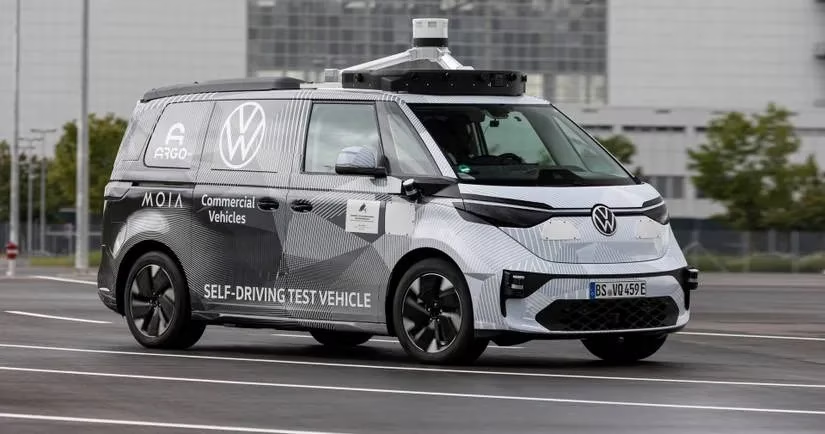
However, Zyciora is sober about the technological hurdles. Achieving full Level 5 autonomy is a "mind-blowing challenge." A system must cope with every possible weather condition and traffic scenario, which is why he believes relying solely on cameras is insufficient. The future, he suggests, lies in a robust sensor fusion of cameras, LiDAR, and radar.
The Eternal Grin: Preserving the Driver's Car
With this autonomous, electric future on the horizon, does the "driver's car" face extinction? Here, Zyciora, now overseeing iconic brands like Porsche within the VW Group, offers a reassuring perspective. He draws a parallel to horseback riding. "What is horse riding today? An experience, something for well-equipped and well-trained sportsmen and recreation," he notes. The emotional thrill of driving, the pursuit of a faster lap time, the sheer joy that makes you "grin from ear to ear" in a Porsche—these are cultural and experiential treasures that won't be discarded.
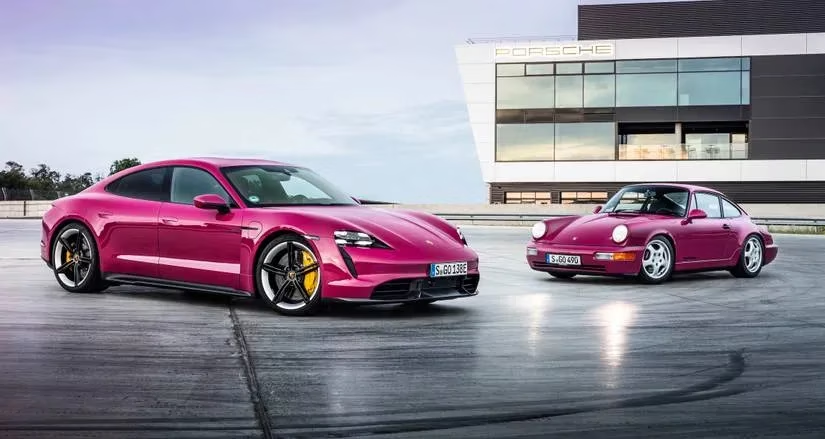
He sees this pursuit of performance as a crucial engine for innovation itself. "We all want to maintain the freedom of mobility," he concludes. So, while the daily commute may become a serene, autonomous experience, the weekend canyon run or track day will remain a sacred space for human skill and mechanical passion. In Klaus Zyciora's vision, the future of automotive design isn't a monolithic shift to sterile pods. It's a diverse landscape where silent, spacious EVs and autonomous shuttles coexist with thrilling, emotive machines that continue to celebrate the pure joy of driving. The soul of the automobile, it seems, is adaptable, and it's just getting ready for its next, electrifying chapter.
Leave a Comment