
Toyota's Hydrogen Vision: The Mirai's Evolution as a Beacon of Sustainable Mobility
Toyota's hydrogen-powered Mirai offers a compelling, elegant alternative to battery electric vehicles, showcasing advanced fuel cell technology for a cleaner future.
In the grand theater of automotive innovation, where the spotlight often shines on the electric revolution, a quiet yet profound alternative script is being written. Toyota, the venerable Japanese automaker, continues to chart its own course, placing a steadfast bet on hydrogen as a cornerstone for a cleaner future. While the industry chorus swells for battery electric vehicles, Toyota's commitment to hydrogen fuel cell technology, embodied in the evolution of the Mirai, represents a deliberate and poetic counterpoint—a belief in a symphony of solutions rather than a single, dominant note. The updated Mirai, unveiled in late 2019, is not merely a car; it is a statement, a vessel of water vapor and ambition, gliding silently towards a horizon less defined by compromise.
The Phoenix: A Redesigned Vision
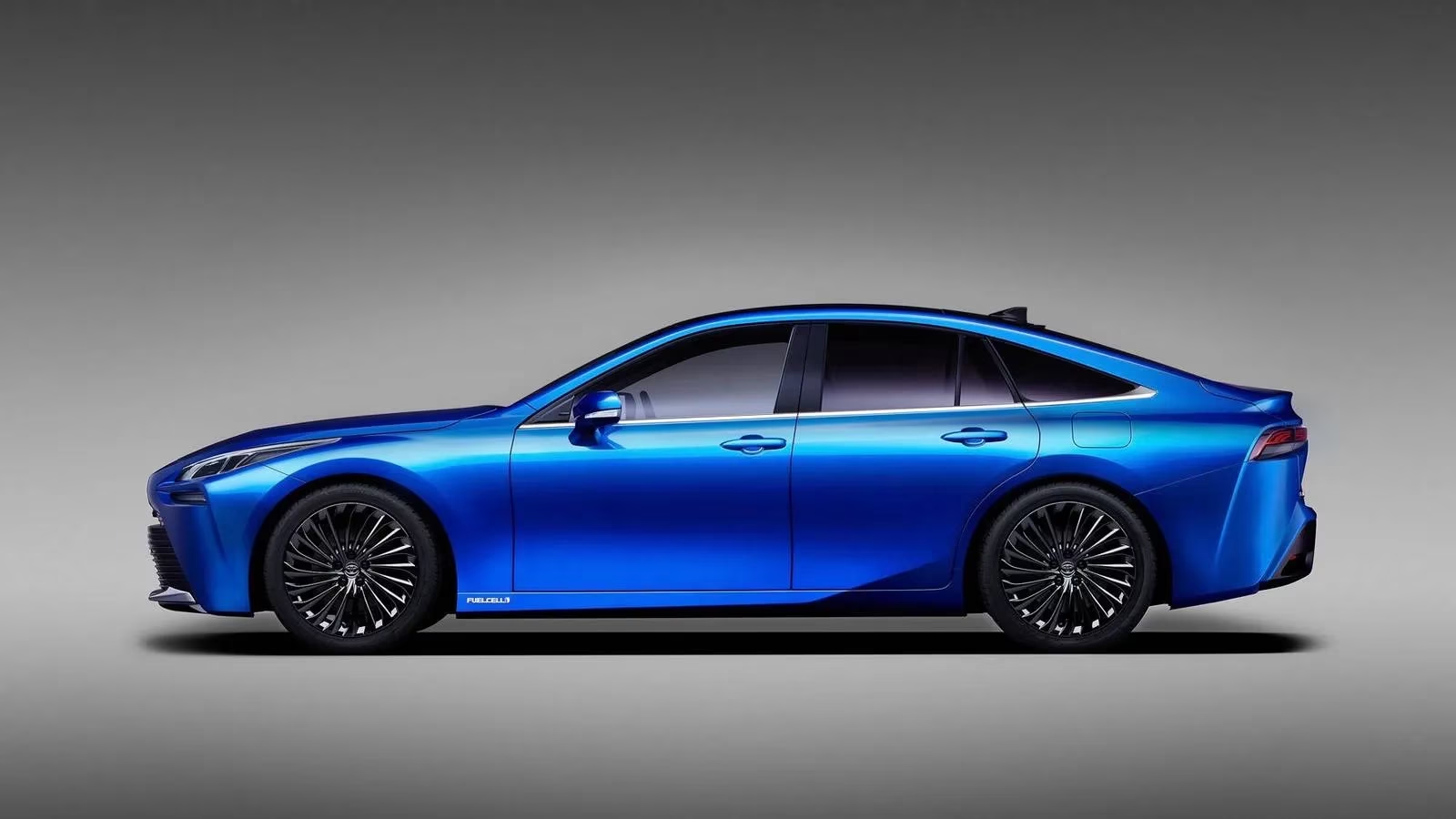
The Mirai, whose name translates to "future" in Japanese, has undergone a metamorphosis as striking as a caterpillar's transformation into a butterfly. Moving from its original, more utilitarian design, the new model is built upon the sophisticated architecture shared with Toyota's luxury Lexus LS sedan and LC coupe. This foundation grants it an "elegant, sporty design" that promises not just aesthetic appeal but also increased passenger room and comfort. The vehicle's silhouette now speaks a language of refined dynamism, a far cry from its predecessor, which first graced the stage at the 2014 Los Angeles Auto Show and later earned the 2016 World Green Car of the Year laurel. This redesign is Toyota's testament to the idea that sustainable technology need not sacrifice elegance or driving pleasure.
The Alchemy of Motion: How the Mirai Breathes
At the heart of the Mirai lies a marvel of modern engineering—a fuel cell stack that performs a kind of alchemy. It takes compressed hydrogen gas from its tanks and marries it with oxygen drawn from the very air we breathe. Within this electrochemical union, electricity is born, quietly powering the vehicle's motor and replenishing a small onboard battery. The only exhaust from this process is pure water vapor, making the Mirai's journey as clean as a mountain stream. This technology positions hydrogen not as a rival to battery electric power, but as a complementary force in Toyota's broader electrification strategy. By 2026, the company aims for electrified vehicles—a category encompassing hybrids, plug-ins, battery electric, and fuel cell vehicles—to constitute nearly half of its global sales, a vision where the Mirai plays a crucial, specialized role.
The Extended Horizon: Performance and Practicality
The advancements in the new Mirai are quantifiable and significant. Toyota engineers have overhauled the fuel cell stack and hydrogen storage systems, enabling the vehicle to carry more fuel. The result is a dramatic 30% increase in driving range compared to the previous model, which could travel approximately 312 miles on a full charge of hydrogen. While Toyota has not specified the exact range for the latest iteration, this improvement shatters a key barrier for adoption. Furthermore, refueling remains a distinct advantage, with the process taking a mere 3 to 5 minutes—a blink of an eye compared to the lengthy charging sessions of many battery electric vehicles. This combination of extended range and rapid refueling makes the Mirai a compelling proposition for those who crave zero-emission mobility without the constraints of long charging stops.
Navigating the Current Landscape
Despite its promise, the Mirai's journey unfolds on a road less traveled. The infrastructure for hydrogen refueling remains in its infancy, a sparse network of oases in a desert dominated by gasoline and growing electric charging stations. As of its last major sales update, Toyota had sold approximately 10,000 Mirai units worldwide since its 2014 launch, with about 1,700 finding homes in the United States in a recent year. At one point, the Mirai commanded over 80% of the operational hydrogen fuel cell vehicles in the U.S., a testament to its pioneering status but also an indicator of the niche market it occupies. In the broader electric vehicle arena, Toyota's volume has historically paled next to giants like Tesla, which sold hundreds of thousands of units annually. Yet, Toyota's strategy appears less about winning a sprint and more about enduring a marathon, patiently cultivating the hydrogen ecosystem while concurrently expanding its entire electrified portfolio.
The Poetic Promise: Metaphors for a New Era
To understand Toyota's hydrogen endeavor, one might see the Mirai not just as a car, but as a mobile dew pond, condensing the potential of the universe's most abundant element into graceful, silent motion. Its fuel cell stack is akin to a mechanical lotus, blooming with electrochemical reactions that purify the act of propulsion, leaving behind only the essence of life—water. And the vehicle itself, in the context of a carbon-heavy transport sector, stands as a silver needle stitching a seam of clarity across a fabric clouded by emissions, weaving a new pattern for how we move.
The Road Ahead to 2026 and Beyond
As we look toward 2026, the narrative around hydrogen is evolving. The updated Mirai, launched in Japan in late 2020 followed by North America and Europe, serves as a critical proof point. Its success hinges on the parallel development of green hydrogen production (made using renewable energy) and a more robust refueling infrastructure. Toyota's persistence signals a long-term conviction that for certain applications—long-haul trucking, intensive commercial use, and for drivers who value rapid energy replenishment—hydrogen fuel cells offer an indispensable solution. The Mirai, therefore, is both a product and a pioneer, a tangible step in a journey toward a diversified, decarbonized future where the whisper of a hydrogen-powered motor might one day be as commonplace as the hum of an electric motor. In Toyota's vision, the future is not monolithic; it is a mosaic, and the Mirai is one of its most carefully crafted, gleaming tiles.
Leave a Comment