
The Silent Symphony: BMW's Hydrogen-Powered iX5 and the Future of Mobility
Explore the groundbreaking BMW iX5 Hydrogen, a revolutionary fuel cell electric vehicle (FCEV) that offers a swift refueling experience and zero emissions, showcasing the future of sustainable mobility.
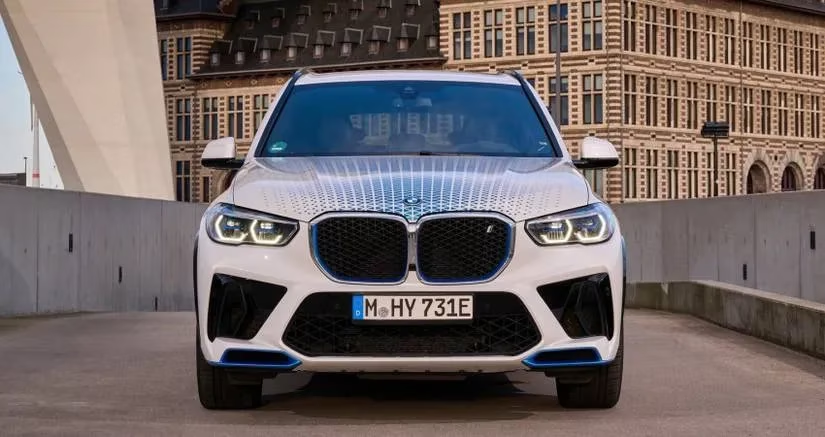
In the vast, humming orchestra of electric vehicle innovation, where the dominant melody has long been the deep bass of lithium-ion batteries, a new, ethereal note is being played. It is the sound of hydrogen—the universe's lightest element—conducted by the steady hand of Bavarian engineering. The BMW iX5 Hydrogen is not merely a car; it is a declaration, a mobile hypothesis rolling on 22-inch wheels, testing whether the future of personal transport can be as clean as a mountain stream and as practical as a morning commute. Born from a concept unveiled in 2019 and nurtured through years of meticulous development, this limited fleet of under 100 vehicles represents a chrysalis stage in automotive evolution, a promise of what may become commonplace by the decade's end.
A Powertrain of Poetic Engineering
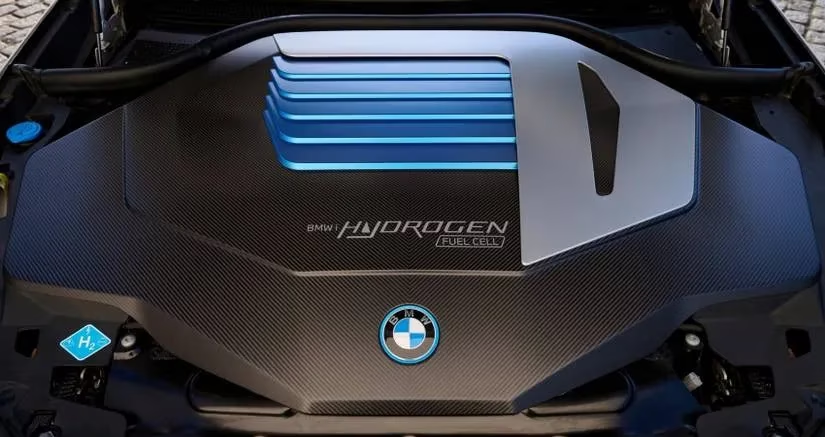
At the heart of the iX5 Hydrogen lies a technological sonnet. Its powertrain is a symphony of silent conversion, where hydrogen and oxygen perform a delicate dance within the fuel cell stack. Unlike a battery-electric vehicle that stores its song in a chemical vault, the FCEV composes its electricity on demand. The process is elegantly simple yet profound: hydrogen from the onboard tanks meets oxygen drawn from the surrounding air. Their union within the fuel cell generates the electrical current that powers the SUV's fifth-generation eDrive motor on the rear axle, producing a potent 401 horsepower. The only emission from this alchemical reaction is pure water vapor—a byproduct so benign it could be mistaken for morning dew. This system even acts as an atmospheric scrubbing brush; the air intake passes through a sophisticated three-stage purification system, making the vehicle a giant, rolling air purifier that leaves the air cleaner in its wake.
The Art of Containment and the Agony of Access
What truly sets the iX5 Hydrogen apart is its relationship with energy and distance. Its two carbon-fiber-reinforced plastic tanks, pressurized to 700 bar, are vessels of potential, holding six kilograms of hydrogen. This translates to a range of approximately 313 miles—a distance that paints a picture of a six-hour journey through changing landscapes. Refueling this potential is, in theory, a moment's work: a three-to-four-minute stop, a blink compared to the half-hour or more required by many battery chargers. It is a promise of convenience as swift as a barista crafting a latte.
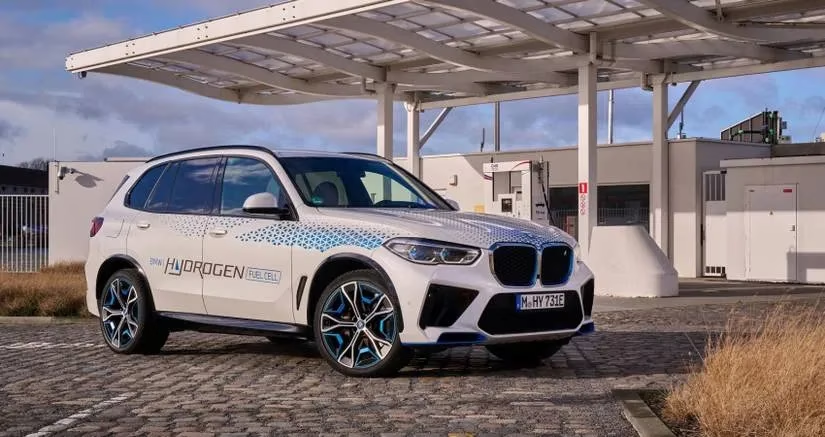
Yet, here lies the central paradox, the Achilles' heel woven from the very fabric of its promise. This swift refueling is a mirage for most. As of 2026, the infrastructure for hydrogen remains a sparse archipelago in a vast sea of asphalt. In the United States, a country of continental scale, only a little over a hundred public hydrogen stations exist, with nearly half clustered in California. For a driver outside this oasis, the 313-mile range becomes not a liberation, but a tether, a radius of action that ends all too soon unless the journey is meticulously plotted like a sailor navigating by ancient stars. The vehicle's brilliant engineering is thus held hostage by a nascent refueling network, a reminder that technological leaps require societal strides to match.
| Aspect | BMW iX5 Hydrogen | Typical Battery EV |
|---|---|---|
| Energy Source | Compressed Hydrogen Gas | Grid Electricity (Battery) |
| Primary Emission | Water Vapor 🚰 | Zero (at point of use) |
| Refuel/Recharge Time | ~4 minutes ⚡ | 30 minutes to several hours ⏳ |
| Major 2026 Challenge | Sparse Refueling Infrastructure 🗺️ | Grid Capacity & Charging Speed 🔌 |
The Pilot's Journey: From Show Car to Global Ambassador
The current fleet of iX5 Hydrogen vehicles are not consumer products but emissaries. They are the first butterflies emerging from BMW's developmental cocoon, tasked with a critical mission: demonstration and data collection. Their journey began in the controlled environments of auto shows and as shuttle vehicles at events like IAA Mobility 2021. Now, they are being placed in the hands of select groups—automotive press, policymakers, and sustainability influencers—to build tangible understanding and shape the conversation around hydrogen mobility. This strategic rollout is particularly poignant for European legislators, who have charted a course toward a 2035 ban on new internal combustion engines. The iX5 Hydrogen offers them a tangible vision of one possible alternative future.
Gazing Toward the Horizon: 2030 and Beyond
BMW's roadmap is clear, if patient. The iX5 Hydrogen, in a production form available to the public, is not slated for arrival until around 2030. This timeline is not an admission of failure but a recognition of scale. It aligns with ambitious infrastructure projections, such as the goal in the United States to expand the network to over 4,300 hydrogen stations by that same year. The interim period is a necessary incubation, a time for the technology to prove its durability, for costs to descend the curve of experience, and for the global energy puzzle to find a place for green hydrogen produced from renewable sources.
The BMW iX5 Hydrogen, therefore, is more than a car. It is a mobile question mark gliding silently down the autobahn. It asks if society values the speed of refueling enough to build a new energy network. It wonders if the elegance of a water-only exhaust can outweigh the current logistical tango. It is a beautiful, complex, and challenging prototype for a future where clean mobility wears many faces. For now, it drives in a limited sphere, a whisper of hydrogen power against the loud, established chorus of electrons and hydrocarbons, waiting for the world to build it a stage worthy of its performance.
Leave a Comment