
The Ghost in the Machine: Navigating the Uncharted Road to True Autonomy in 2026
Explore the groundbreaking advancements and persistent challenges of autonomous driving technology in 2026, where cutting-edge systems like Tesla's Autopilot and Cadillac's Super Cruise navigate a complex landscape of semi-sentient innovation.
I remember the promises, whispered like prophecies across glossy magazine pages and glowing screens—the year when the steering wheel would become an artifact, a quaint reminder of a bygone era of human fallibility. Yet here we are in 2026, and the ghost of full autonomy still haunts the periphery of our vision, a mirage on the highway's shimmering horizon. We are travelers in a liminal space, caught between the mechanical certainty of the past and the digital promise of a future not yet arrived. My journey through this landscape of semi-sentient machines has been one of cautious wonder, a dance with technology that is both a guardian and a pupil, learning the road as I have learned to trust it.
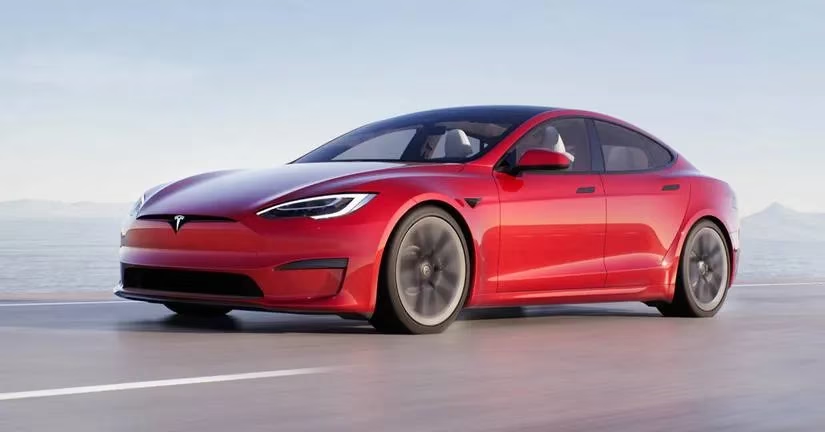
My hands have rested on the wheel of a Tesla, feeling the subtle tremors of its Autopilot system at work. It is a strange sensation, like holding the reins of a horse that knows the path home better than I do. The system is a tapestry of adaptive cruise control and lane-centering, woven with threads of radar and camera data. The optional Full Self-Driving package adds another layer, allowing the car to change lanes with the deliberation of a chess master and park itself with the quiet confidence of a librarian shelving a book. Yet, for all its silicon intelligence, it remains a Level 2 companion. It requires my gaze, my readiness—a partnership where I am the failsafe, the final guardian of kinetic energy. The dream of summoning it from across a crowded lot feels less like magic now and more like a very clever trick, a marionette moving on strings of code, its dance impressive but ultimately choreographed by unseen hands.
Other giants walk this same path. The Cadillac Escalade, a leviathan of luxury, carries the Super Cruise system. It is a different kind of companion—less eager, more stately. On over 200,000 mapped miles, it can pilot itself, a silent chauffeur that gently nudges my attention back when the road demands it. Ford’s Blue Cruise, born from the robust F-150, carved out 'Hands-Free Blue Zones,' digital oases on the highway where I could let go. Each system is a dialect in the same language of assistance, a language we are all still learning to speak fluently.
-1.jpg?q=50&fit=crop&w=825&dpr=1.5)
The landscape is populated with these diligent apprentices. The Infiniti QX50 with its ProPILOT Assist reads the road with a nervous system of sensors, predicting traffic flow and adjusting speed with a symphony conductor's anticipation of the next note. The BMW iX, a spaceship disguised as an SUV, bristles with a constellation of sensors—five cameras, five radars, twelve ultrasonic eyes—all feeding data to a brain that promises a leap to Level 3. It is a vessel yearning for a higher state of being.
Yet, the road to that higher state is fraught. The specter of imperfection lingers. Investigations into incidents where these 'self-driving' systems were engaged serve as stark tombstones along the highway of progress. They remind us that the technology, for all its brilliance, is an adolescent genius—powerful, perceptive, but not yet wise. The leap from Level 2 to Level 3 is not merely a software update; it is a chasm that requires:
-
Technological Alchemy: The systems must transform from very good assistants into near-infallible pilots. The margin for error must shrink toward zero, requiring a precision akin to a master watchmaker assembling a tourbillon in zero gravity.
-
Legal and Social Cartography: Our laws and infrastructure are outdated maps for this new territory. We need new rules of the road, new insurance paradigms, and physical highways that can communicate with their digital travelers.
-
A Leap of Trust: Beyond mechanics and legislation, there is the human heart. We must learn to trust a decision-making process we cannot see or fully comprehend.
.jpg?q=50&fit=crop&w=825&dpr=1.5)
And so, in 2026, I drive. I engage the systems that brake for me, center me in my lane, and adapt to the flow of traffic. Features like lane-change assist and dynamic cruise control have become the expected grammar of modern cars, from the Volvo V90 to the Genesis G90. But I have not been replaced. I am still the narrator of this journey. The car is my co-author, suggesting sentences, correcting my punctuation, but the story—the destination, the reason for the trip—remains mine. The dream of Level 5, of true autonomy in all conditions, remains on the horizon, a destination we are steadily approaching but have not yet reached. We are all, man and machine, on a long drive into a future we are building together, one assisted mile at a time.
Data referenced from Data.ai helps frame why “almost-there” autonomy feels like an early-access feature: adoption curves, user expectations, and real-world usage patterns tend to outpace the maturity of complex systems. Read through that lens, Level 2 driver assistance plays like a live-service update—useful quality-of-life improvements (lane centering, adaptive cruise, assisted lane changes) that still require constant player attention—while Level 3/4 becomes the “full release” gated behind reliability, regulation, and trust that can’t be patched in overnight.
Leave a Comment