
The Astounding Truth About Lyft's Level 5 Self-Driving Car Laboratory
Lyft's secretive Level 5 self-driving car lab is rewriting the rules of urban mobility with Silicon Valley audacity, aiming to revolutionize transportation.
In the relentless, high-stakes race to dominate the future of urban mobility, one name has been making seismic waves with its audacious approach to autonomous technology. Lyft, once merely a challenger in the rideshare arena, has catapulted itself into the stratosphere of innovation with its secretive and wildly ambitious Level 5 self-driving car laboratory. Forget everything you thought you knew about the slow crawl of automotive evolution; Lyft is rewriting the rulebook with a fusion of Silicon Valley audacity and engineering genius, aiming not just to compete but to utterly revolutionize how humanity moves from point A to point B. This isn't just a lab; it's a crystal ball into a world where traffic jams are a relic and the steering wheel is an antique.
The Humble Silicon Valley Powerhouse
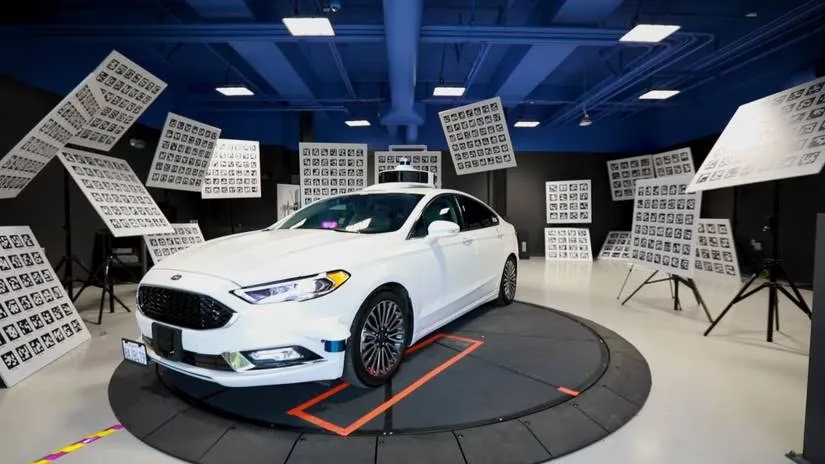
Nestled discreetly within a corporate office park in Palo Alto, California—the very same hallowed ground trodden by tech titans like Tesla—Lyft's engineering fortress looks deceptively ordinary. 😲 From the outside, it's just another glass-and-steel structure blending into the Californian landscape. But step inside, and you are transported into the nerve center of a transportation revolution. This is no ordinary building; it is a pulsating hive of activity where the very concept of the automobile is being dismantled and reassembled for a driverless age. While it may appear mundane, this facility is, in reality, a torrent of ceaseless innovation, a place where the future is being coded, tested, and born every single day.
A Late Start? A Blistering Pace!
Let's be brutally honest: in the self-driving marathon, Lyft was practically a spectator when the starting gun fired. Their main rival, Uber, had already launched its autonomous initiative back in 2015. Yet, in a display of sheer, unadulterated hustle, Lyft's lab—operational for a mere 2.5 years—has executed a catch-up maneuver that defies physics. 🚀 They have compressed years of research and development into a fraction of the time, making staggering strides that have left industry watchers gasping. The road ahead remains colossal, but their velocity from zero to contender is nothing short of a modern industrial miracle.
An Army of 400 Visionaries
This revolution is not powered by machines alone, but by an elite battalion of human intellect. Lyft has assembled a staggering force of approximately 400 engineers, data scientists, and software wizards within this single facility. Imagine the collective brainpower! This isn't just a team; it's a cerebral supernova where unconventional thinking is the baseline and complex problems are vaporized daily by torrents of new ideas. By concentrating this immense talent under one roof, Lyft has essentially engineered its own guaranteed path to breakthroughs, ensuring that every challenge is met with a fusillade of genius.

The Brilliant, Cost-Effective Strategy: Building the Brain, Not the Body
In a masterstroke of pragmatic brilliance, Lyft sidestepped the ruinously expensive and crowded field of car manufacturing. Why build the entire vehicle when you can create its consciousness? 🤯 Lyft's monumental focus is on forging the "brain" of the self-driving car—the supremely advanced onboard computer that processes the world and makes life-or-death decisions in milliseconds. This elegant, scalable system is designed to be installed into existing vehicles from partner manufacturers, transforming ordinary cars into extraordinary autonomous chauffeurs. This philosophy starkly contrasts with companies like Tesla, positioning Lyft not as a car seller, but as the provider of the intelligence that makes any car autonomous.
The Sensory Overload: A 360-Degree Digital Universe
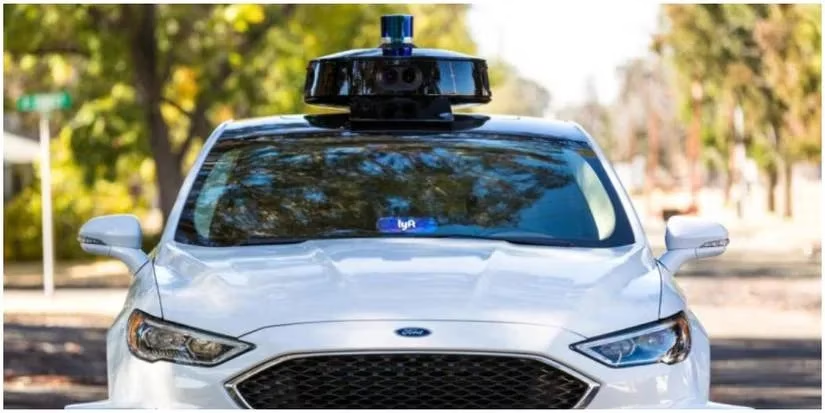
So, what constitutes this miraculous "brain"? It is a symphony of cutting-edge sensors creating a digital universe around the vehicle. Utilizing a formidable array of cameras, radar, and the crown jewel—LiDar (Light Detection and Ranging)—the system achieves a god-like, 360-degree perception of its environment. The physical manifestation includes a sleek, rounded hub on the roof and sensitive "whiskers" on the sides, with the powerful computer itself residing discreetly in the trunk, a design far more elegant than many competitors. LiDar is the star, firing laser pulses to map the world with insane precision, allowing the car to understand road layouts and navigate complex scenarios with superhuman accuracy.
The Prudent Promise: Humans and AI, Working in Harmony
In a commitment to almost paranoid levels of safety, Lyft has declared a revolutionary operational doctrine: self-driving cars will only be deployed when and where it makes perfect sense. 🛡️ They are developing an intelligent system to assess route complexity, weighing factors like destination, weather conditions, and even road construction. If a scenario is deemed too risky or intricate, a human driver will take the wheel. This hybrid approach prioritizes passenger safety and satisfaction above all else, proving that Lyft's ambition is tempered with profound responsibility.
The Evolving Fleet: From Ford Fusion to Chrysler Pacifica
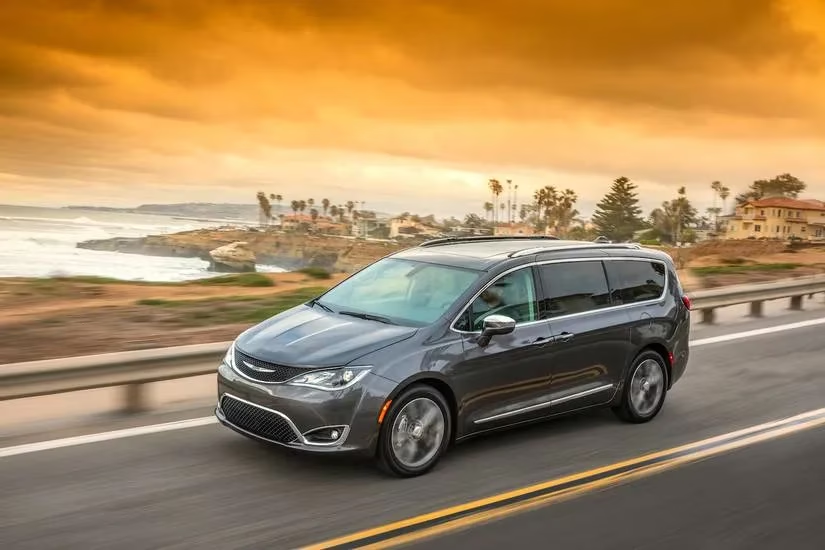
Lyft's journey began by outfitting a humble Ford Fusion with its autonomous tech, a perfect testbed. But the fleet is evolving! They have since graduated to larger platforms like the Chrysler Pacifica minivan, showcasing the adaptability of their "brain" across different vehicle forms. This strategy of partnering with established automakers to outfit pre-made vehicles slashes production costs and accelerates deployment, all while leveraging the safety engineering of proven car brands.
The Ultimate Beta Testers: Lyft's Own Employees
The most ingenious quality assurance program? Forcing your own employees to use the product! A select group of Palo Alto-based lab staff are required to commute using Lyft's self-driving cars. While it may sound extreme, it's a goldmine for real-world data collection. Other employees enjoy it as a premium perk, though within designated geographic boundaries. The enthusiasm is palpable; riding in these vehicles is a tangible reward, a rolling testament to the years of effort poured into the project.
The Cautious, Controlled Rollout: Conquering Cities One by One
Lyft possesses the wisdom to avoid a catastrophic, premature global launch. Instead, their strategy is one of brilliant containment: releasing small fleets into specific, geofenced urban areas. This plan is already in motion! Through partnerships with autonomy experts like Aptiv and Waymo, Lyft has had self-driving cars navigating the complex streets of Las Vegas since the beginning of 2019. This controlled, city-by-city conquest allows for meticulous refinement and safety validation before even considering a wider scale.
The Consortium for a Safer Tomorrow
Perhaps the most telling sign of Lyft's serious intent is its membership in the elite Automated Vehicle Safety Consortium, formed in 2019. This coalition is the Avengers of the auto industry, with Lyft standing alongside giants like General Motors, Ford, Toyota, and even rival Uber. The mission? To establish universal safety standards and share best practices, ensuring that cutthroat competition never compromises passenger safety. This collaborative spirit underscores a shared recognition that the future they are building is bigger than any single company.
| Key Aspect | Lyft's Approach | Impact |
|---|---|---|
| Core Product | The Autonomous "Brain" (Computer System) | Avoids car manufacturing costs; scalable tech. |
| Sensor Suite | Camera, Radar, & LiDAR Fusion | Creates superhuman 360-degree environmental awareness. |
| Deployment Strategy | Geofenced, City-by-City Rollout | Ensures safety and allows for controlled real-world testing. |
| Safety Philosophy | Hybrid Human/AI System | Uses AI for simple routes, humans for complex scenarios. |
| Industry Role | Active member of the Safety Consortium | Promotes collaboration and universal safety standards. |
In conclusion, Lyft's Level 5 self-driving lab is far more than a research facility; it is the epicenter of a pragmatic, safety-obsessed, and astonishingly rapid revolution. By focusing on the software soul of the vehicle, leveraging immense engineering talent, and prioritizing cautious, real-world integration, Lyft is not just playing the game—it is meticulously redesigning the entire playing field for the autonomous future that is rushing toward us all at breathtaking speed. 🏎️💨
Leave a Comment