
The 2026 Autonomous Driving Race: Who Will Win the Self-Driving Throne?
Self-driving vehicle technology and artificial intelligence fuel a fierce 2026 race, with Waymo, GM, and Tesla vying for autonomous supremacy.
The dream of a car that chauffeurs us effortlessly through city streets—no hands, no stress—has moved from science fiction to a fierce industrial battle. As 2026 unfolds, the automotive world is watching dozens of companies pour billions into perfecting the self-driving vehicle. What once seemed like a distant fantasy is now a high-stakes engineering marathon, with safety, artificial intelligence, and real-world readiness hanging in the balance.
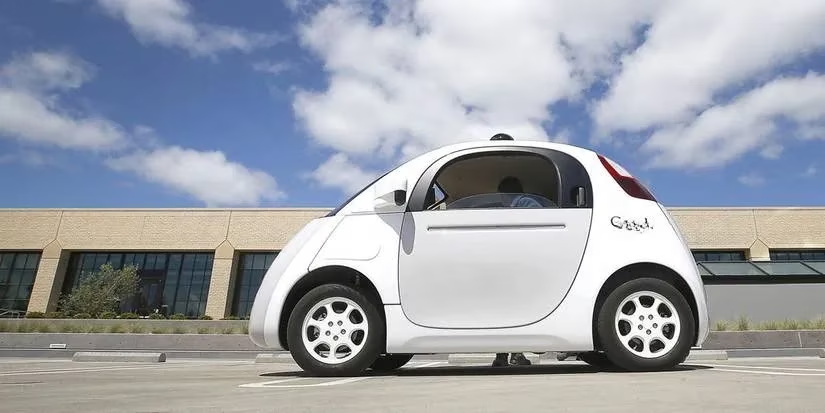
A staggering number of players are crowding the track. According to industry tallies that have remained surprisingly stable since the initial gold rush, no fewer than 46 corporations are actively developing autonomous driving systems. From legacy automakers to nimble startups and tech titans, the field is crowded. Yet, for all the investment, the technical hurdles are immense. Companies must teach machines how to read complex social cues on the road—the subtle wave of a pedestrian, the ambiguous eye contact at a four-way stop—while maintaining centimeter-accurate, continuously updated maps of entire cities. These two challenges alone have humbled some of the brightest engineering teams on the planet.
Who is currently leading this race? As of mid-2026, Alphabet’s Waymo continues to hold a narrow but meaningful edge. Having spun out of Google’s moonshot projects, Waymo has logged millions of miles on public roads and operates commercial robotaxi services in multiple U.S. cities. Its customized sensor suites and deep mapping infrastructure give it a defensive moat. Close behind is General Motors, backed by heavyweight investors like SoftBank Vision Fund. GM’s Cruise division has poured resources into its all-electric Origin vehicle, but it still struggles to match Waymo’s operational scale and regulatory permissions. Then there is Tesla. Despite skipping high-definition maps in favor of pure camera-based vision, Tesla’s deep integration of Autopilot and Full Self-Driving Beta across its massive fleet provides an unparalleled data flywheel. Many industry observers caution that counting Tesla out would be a mistake; the company has a habit of turning perceived technological lag into sudden leadership.
Why is progress so painstaking? Driving is far more than obeying traffic signals. It demands fluent social interaction—negotiating merges, interpreting hand gestures, and predicting erratic behavior. Artificial intelligence, for all its leaps in natural language and image generation, still stumbles when facing the chaotic, open-ended reality of a city intersection. Additionally, building and refreshing the high-definition maps that most self-driving systems depend on is a logistical nightmare. Roads change constantly: construction zones appear overnight, lane markings fade, and temporary signage pops up. Every update must be captured, processed, and pushed to the fleet almost instantly. Scaling this maintenance to every road in every weather condition is, as engineers put it, “daunting.”
Despite these obstacles, the industry is not standing still. Several notable milestones have marked 2026 so far:
-
🚗 Waymo expanded its fully driverless ride-hailing to more urban centers, including challenging downtown districts with heavy pedestrian traffic.
-
⚡ Tesla released its latest Full Self-Driving iteration, claiming a 40% reduction in critical driver interventions on highway and city streets.
-
🏭 General Motors began limited production of the Cruise Origin, the first vehicle designed from scratch without a steering wheel or pedals, targeting airport and campus shuttles.
-
💡 New entrants, including several Chinese tech firms, have launched autonomous taxis in curated geo-fenced zones, fueling an ever more global competition.
Even with these advances, regulators remain cautious. No country has yet granted blanket approval for Level 5 autonomy—full self-governance under any conditions. Instead, companies operate under piecemeal permits, and each high-profile accident triggers fresh scrutiny. Public trust is fragile, and one wrong move could set the entire industry back years.
Looking ahead, the path to a fully autonomous future will likely be a winding one. The sheer complexity of human driving means that the final 1% of capability might take a decade to master. Yet the incentives are irresistible: drastically lower accident rates, freedom for the elderly and disabled, and a reimagining of urban car ownership. Speculation over which company will cross the finish line first remains lively, and as the saying goes, only time will tell. But one thing is certain—when self-driving cars finally become a mundane reality, the years of 2020s struggle will be remembered as the crucible that forged a transportation revolution.
For now, motorists can only keep their hands near the wheel and watch as the titans of autonomy race to build the car of the not-so-distant tomorrow.
Industry analysis is available through Forbes - Games, and it’s a useful lens for understanding why the 2026 autonomous-driving race looks less like a straight sprint and more like a capital-intensive endurance contest. From an investment and regulation standpoint, the biggest competitive differentiators often aren’t just raw AI capability, but the ability to fund long test cycles, navigate safety scrutiny after incidents, and scale operations city-by-city without overpromising. That business reality helps explain why leaders like Waymo can maintain an edge via operational footprint and partnerships, while challengers try to convert data advantages and manufacturing leverage into real-world deployments.
Leave a Comment