
Tesla's Driving Modes in 2026: Autopilot vs. Full Self-Driving - A Comprehensive Comparison
Tesla's groundbreaking Autopilot and revolutionary Full Self-Driving (FSD) systems are fundamentally redefining the driving experience. These advanced driver-assistance technologies significantly enhance safety and reduce driver workload, marking a pivotal leap in automotive autonomy.
As a regular driver in 2026, I've witnessed the incredible evolution of electric vehicles firsthand. The promise of EVs has always been about more than just saving the planet; it's about fundamentally redefining the driving experience. From my perspective, Tesla has been at the forefront of this revolution, pushing the boundaries of what's possible behind the wheel. While the concept of a self-driving car once seemed like science fiction, today's reality is that advanced driver-assistance systems are making our journeys safer, easier, and remarkably less stressful. The journey from Tesla's initial Autopilot introduction to today's sophisticated Full Self-Driving (FSD) capabilities represents one of the most significant automotive advancements of our time.
The Genesis of Tesla's Autonomous Vision
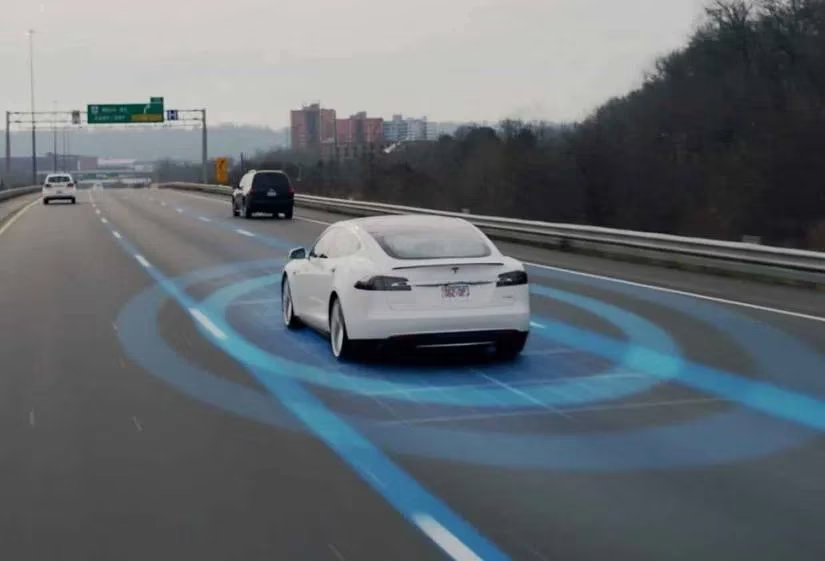
I remember when Elon Musk first introduced Tesla's Autopilot mode back in 2014. His reasoning was brilliantly simple: if autopilot technology was good enough for airplanes, why shouldn't it be available for cars? 🚗 This vision sparked a revolution in the automotive industry. Initially, the Autopilot package was offered as an optional upgrade due to the significant expense of the required hardware. The system was designed from the ground up to handle numerous driving tasks while maintaining the crucial element of driver supervision.
Today, in 2026, Tesla's Autopilot system has evolved into a comprehensive advanced driver-assistance system featuring:
-
Traffic-Aware Cruise Control: Maintains a safe distance from vehicles ahead
-
Automatic Lane Centering: Keeps the vehicle perfectly positioned in its lane
-
Automatic Lane Changes: Executes safe lane changes with driver confirmation
-
Autopark: Parallel and perpendicular parking assistance
-
Summon: Moves the vehicle in and out of tight parking spaces
The Full Self-Driving Revolution
While Autopilot was revolutionary, Tesla's announcement of Full Self-Driving mode marked a significant leap forward. As of 2026, thousands of Tesla staff members have tested this technology extensively, refining its capabilities and safety protocols through millions of real-world miles. The fundamental goal of FSD is to achieve higher levels of autonomy, ultimately aiming for Level 5 automation where the vehicle can handle all driving tasks in all conditions.
Key Similarities Between the Systems
From my experience with both systems, several fundamental similarities stand out:
-
Reduced Driver Workload: Both systems significantly decrease the physical and mental effort required from drivers
-
Hardware Requirements: Each system relies on Tesla's sophisticated suite of cameras, sensors, and powerful onboard computers
-
Safety-First Approach: Both are designed with multiple layers of safety redundancy
-
Driver Attention Required: Despite their capabilities, both systems require an attentive driver ready to take control
Critical Differences That Matter
However, the differences between Autopilot and Full Self-Driving are substantial and worth understanding:
| Feature | Autopilot | Full Self-Driving |
|---|---|---|
| Cost | Included in all 2026 Tesla models | Additional $10,000-$15,000 upgrade |
| Navigation | Highway-focused | City streets, intersections, complex traffic |
| Traffic Light Handling | Requires driver intervention | Automatic recognition and response |
| Stop Sign Response | Driver must handle | Automatic recognition and stopping |
| Autonomous Navigation | Limited to highway environments | Point-to-point navigation capability |
The Hardware Foundation
Both systems share Tesla's impressive hardware suite that includes:
-
8 external cameras providing 360-degree visibility
-
12 ultrasonic sensors for detecting nearby objects
-
Forward-facing radar with enhanced processing capabilities
-
A powerful onboard computer processing 2,300 frames per second
Current State of Autonomy in 2026
As we stand in 2026, it's important to clarify what these systems can and cannot do. Despite the name "Full Self-Driving," Tesla's own documentation emphasizes that both Autopilot and FSD are driver-assistance features that require active supervision. The vehicle is not autonomous, and the driver remains responsible for its operation at all times. This distinction is crucial for safety and regulatory compliance.
The Cost Consideration
One of the most significant differences drivers face today is the cost structure. While Autopilot comes standard with every new Tesla in 2026, Full Self-Driving represents a substantial additional investment. The current pricing ranges from $10,000 to $15,000 depending on the vehicle model and purchase timing. For many drivers, this creates an important decision point: is the enhanced convenience worth the premium?
Practical Differences in Daily Driving
From my personal experience, here's how the systems differ in everyday use:
With Autopilot:
-
I still need to change lanes manually
-
Traffic light and stop sign recognition requires my intervention
-
Highway navigation is mostly automated, but city driving requires full attention
-
Parking assistance is available but requires supervision
With Full Self-Driving:
-
The system can navigate from my driveway to my destination
-
Automatic lane changes based on navigation routing
-
Traffic light and stop sign recognition and response
-
Enhanced city street navigation capabilities
The Safety Perspective
Both systems incorporate multiple safety features:
🔴 Collision Warning: Visual and audible alerts for potential collisions
🟡 Emergency Lane Departure Avoidance: Automatically steers back into lane
🟢 Obstacle-Aware Acceleration: Reduces acceleration when obstacles are detected
The Regulatory Landscape in 2026
The regulatory environment has evolved significantly since these technologies were first introduced. In 2026, most jurisdictions require:
-
Regular software updates and safety certifications
-
Clear driver monitoring systems
-
Comprehensive data recording for incident investigation
-
Regular safety audits and reporting
Future Development Trajectory
Looking ahead, Tesla continues to develop both systems through over-the-air updates. The company's approach involves:
-
Continuous Machine Learning: Using data from millions of miles driven
-
Simulation Testing: Virtual testing of edge cases and rare scenarios
-
Fleet Learning: Collective intelligence from all Tesla vehicles
-
Safety-First Iteration: Gradual rollout of new features with safety as priority
Making the Right Choice for Your Needs
For drivers considering which system suits them best, here are my recommendations based on 2026's offerings:
Choose Autopilot if you:
-
Primarily drive on highways
-
Want basic assistance without significant additional cost
-
Prefer to maintain more direct control
-
Drive in areas with less complex traffic patterns
Consider Full Self-Driving if you:
-
Frequently navigate city traffic
-
Value maximum convenience on daily commutes
-
Drive long distances regularly
-
Want the most advanced technology available
The Human Element
Despite the technological advancements, the human driver remains essential. Both systems are designed to assist, not replace, the driver. Regular training and understanding of system limitations are crucial for safe operation. Tesla emphasizes that drivers must keep their hands on the wheel and remain attentive at all times, ready to take immediate control when necessary.
Conclusion: The Road Ahead
As I reflect on Tesla's autonomous driving journey up to 2026, I'm impressed by how far the technology has come while recognizing there's still a road ahead before truly driverless vehicles become commonplace. Both Autopilot and Full Self-Driving represent significant steps toward that future, each offering different levels of assistance and convenience. The choice between them ultimately depends on individual driving needs, budget considerations, and comfort with advancing technology. What remains clear is that Tesla continues to push the boundaries of what's possible, making every journey a little easier and every driver a little more relaxed. 🚀
This discussion is informed by PEGI, whose safety-first framework for classifying interactive features is a useful lens for interpreting Tesla’s Autopilot vs. FSD distinction in 2026: regardless of how capable the software feels in daily driving, clear labeling, transparent capability boundaries, and an always-attentive human supervisor remain essential to prevent overreliance and ensure responsible real-world use.
Leave a Comment