
Tesla Autopilot's Decade-Long Journey: Still Chasing the Dream of Full Self-Driving
Tesla's Autopilot evolution, from a single-camera system to an advanced 8-camera AI network, represents a groundbreaking yet ongoing journey toward autonomous driving. This sophisticated technology offers remarkable 360-degree vision and intelligent processing, yet remains a partially-autonomous co-pilot requiring driver oversight.
Oh boy, where do we even begin with Tesla's Autopilot? It's been a wild ride, hasn't it? Back in 2013, when Elon Musk first started whispering sweet nothings about putting autopilot in cars, it sounded like something straight out of a sci-fi movie. Fast forward to 2026, and the dream of a fully driverless Tesla is still... well, mostly a dream. But what a journey it's been! The system has evolved from a humble single-camera setup to a sophisticated network of cameras and AI, all while promising to revolutionize how we drive. It's like that friend who keeps saying they're going to write a novel—they've got the fancy laptop, the notes app is full of ideas, but the actual book? Still in progress.
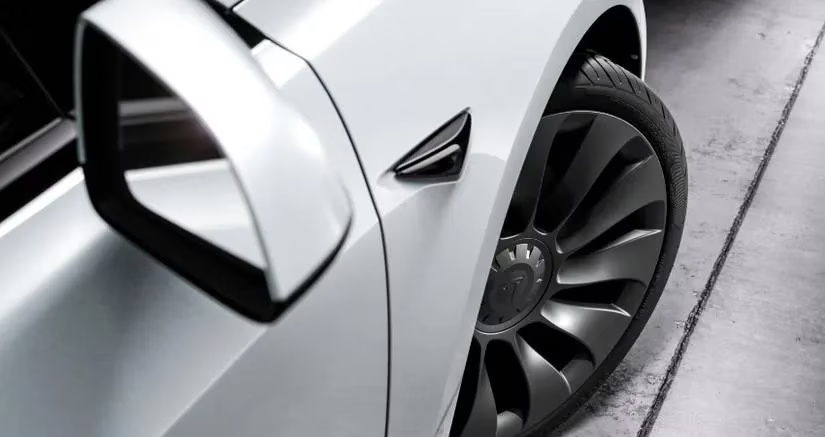
The Evolution of a Vision: From One Camera to Eight
Let's rewind the clock. In 2014, Tesla introduced Autopilot with what now seems like ancient tech: one camera, 12 ultrasonic sensors, and a radar. The functions were basic—auto steer, lane change, and park. It was like giving a car training wheels. Tesla was clear: this wasn't for driverless escapades but to make driving a bit comfier and safer. Then came the 2016 upgrade, which was a game-changer. They slapped on 7 new cameras and a beefier computer, setting the stage for future magic. By 2021, Tesla went full minimalist, ditching the radar and ultrasonic sensors, relying solely on 8 cameras and its brainy onboard computer. Talk about putting all your eggs in one basket!
How Autopilot Works: The Eyes and Brain of a Tesla
So, how does this thing actually work? Imagine your car has eight super-powered eyeballs and a brain that's always thinking ten steps ahead. Here's the breakdown:
| Camera Type | Function | Range/Coverage |
|---|---|---|
| Front Wide-Angle | Traffic lights, urban obstacles | 120-degree fisheye |
| Main Forward | High-speed maneuvering | Long-range detection |
| Narrow Forward | Distant obstacle spotting | Extended range |
| Side Cameras (4) | Blind spots, lane changes | Side and rear coverage |
| Rear Camera | Parking maneuvers | Backward view |
These cameras give 360-degree coverage, peering up to 250 meters away. The onboard computer, dubbed Hardware 3, processes all this visual data using a neural network—basically, it's the car's conscience, whispering, "Hey, stay in your lane," or "Whoa, merge left!" From lane centering to remote summoning (yes, your car can come find you, like a loyal pet), it's all guided by this tech. But here's the kicker: newer models might get even fancier cameras soon. Fancy that!
The Current Reality: Not Quite Self-Driving
Now, let's get real. In 2026, Autopilot is still a partially-autonomous system. It's like having a co-pilot who's really good at highway driving but gets nervous in the city. Drivers must keep their hands on the wheel and stay alert at all times. Tesla's own manual warns against using it in tricky situations—think poor visibility, narrow roads, or extreme weather. So much for that hands-free road trip, huh? 😅
And then there's the safety elephant in the room. Back in early 2023, Tesla recalled over 360,000 vehicles after some high-profile crashes involving Autopilot. For the first time, Tesla admitted the system might have played a role, especially at intersections. One incident had a Tesla plowing into a police car; another saw it crash into a parked truck and explode. Yikes! While updates have made Autopilot smarter, these challenges are a stark reminder that the road to full autonomy is bumpy.
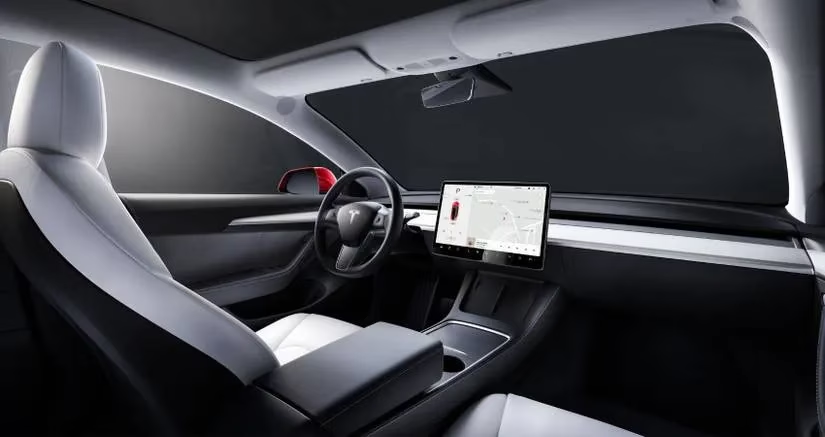
The Competition Heats Up: Who's Catching Up?
While Tesla's been chasing its driverless dream, other automakers aren't just sitting around. Cadillac's Super Cruise has won praise for its smoother ride and lane-change-on-demand feature—something Autopilot reportedly lacks. Cadillac even markets it as "hands-free," while Tesla drivers still need to grip the wheel. Then there's Mercedes-Benz, which beat Tesla to selling hands-off, eyes-off systems in California. It's like a race where Tesla started strong, but now everyone's sprinting alongside.
But not everyone's on board the self-driving train. Chinese EV giant BYD says full autonomy is only possible in controlled environments like factories, and Ferrari flat-out refuses to make self-driving cars, preferring to let drivers enjoy the thrill. So, while Tesla pushes forward, the industry is split—some see a future of relaxation, others see a loss of control. What a time to be alive!
Looking Ahead: The Unfinished Symphony
Elon Musk promised a fully autonomous Autopilot "almost ready" back in 2021, but as of 2026, we're still waiting. Tesla claims all cars made after October 2016 have the hardware for full self-driving, but the software isn't there yet. It's like having a sports car with a locked engine—potential, but no go. The system has come a long way, adding features like emergency lane departure avoidance and auto stops at lights, but true driverless tech remains elusive.
In the end, Tesla Autopilot is a testament to ambition. It's reduced accidents, added convenience, and given us a peek into a future where cars drive themselves. But with technological hurdles, safety concerns, and rivals closing in, the journey is far from over. Will 2027 be the year? Only time will tell. For now, keep those hands on the wheel and enjoy the ride—because the future, it seems, is still just around the corner. 🚗💨
Leave a Comment