
My Journey with Tesla's FSD Beta: From Safety Score to the Open Road
Earning Tesla's Full Self-Driving Beta required a perfect Safety Score, transforming driving into a meticulous performance. This journey unlocked the revolutionary FSD Beta 12.5, marking a pivotal step into autonomous transportation.
The notification on my phone screen felt like a golden ticket. It was late 2025, and after months of anticipation, I had finally been granted access to Tesla's Full Self-Driving Beta. The journey to this moment wasn't just about waiting for a software update; it was a personal challenge, a week-long test of my driving habits orchestrated by an algorithm. The promise was intoxicating: my car, a Model Y, could navigate city streets, handle complex intersections, and make driving decisions on its own. But first, Tesla needed to know if I was ready for it. They didn't just hand over the keys to autonomy; they made me earn them through a meticulous safety evaluation. This was the new frontier of personal transportation, and I was about to step into it, one cautious mile at a time.
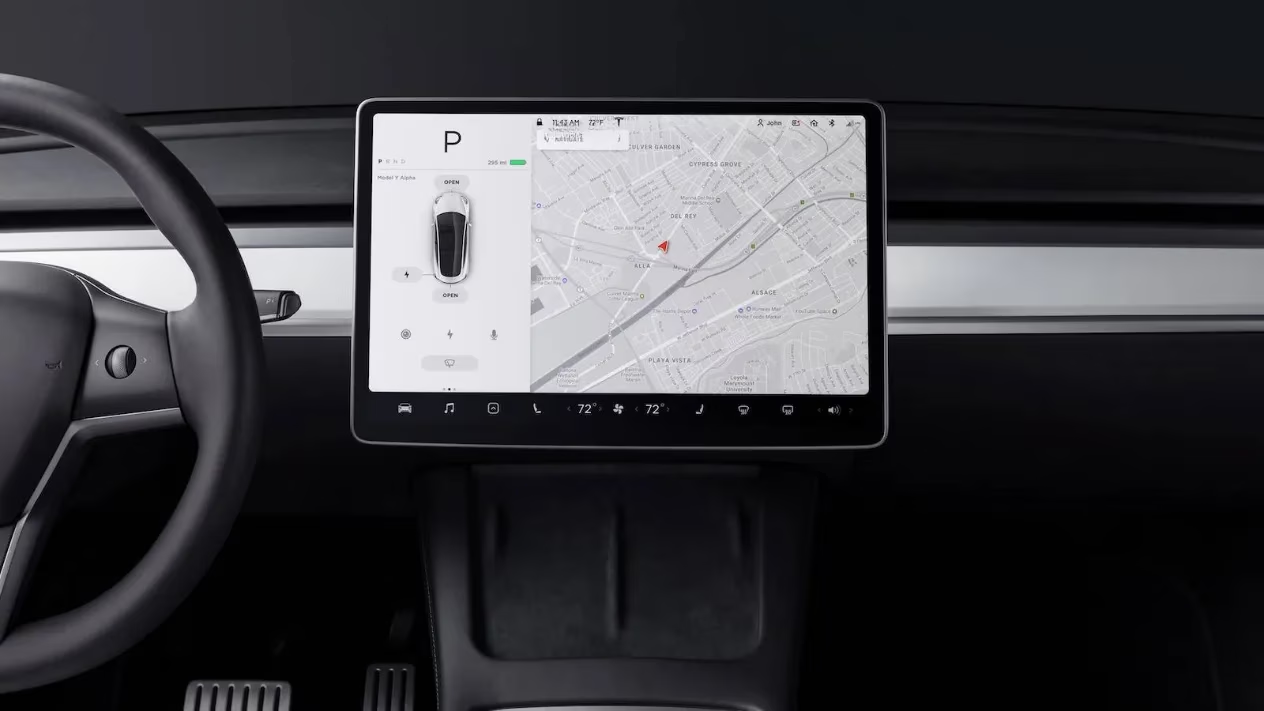
The Gatekeeper: The Elusive Safety Score
Before I could even dream of the beta, I had to confront the gatekeeper: the Tesla Safety Score. This wasn't a simple pass/fail test. It was a dynamic, living scorecard that analyzed my every move behind the wheel. Tesla's system, which had been refined significantly since its initial 2021 beta launch, monitored five critical factors with hawk-like precision:
-
Forward Collision Warnings (FCW): How often did the car think I was about to hit something? Any alert here was a major ding.
-
Hard Braking: Sudden, aggressive stops were a big no-no. Smoothness was king.
-
Aggressive Turning: Taking corners like a race car driver would tank my score.
-
Unsafe Following: Tailgating? The system knew, and it disapproved.
-
Forced Autopilot Disengagement: If I had to forcefully take over from Autopilot, it meant the system encountered something it couldn't handle, which counted against me.
For seven days, I drove over 100 miles with the intensity of a student taking their final exam. Every drive was a performance. I left immense gaps between me and the car ahead. I braked so gently that passengers wondered if the brakes were working. I took corners with the leisurely pace of a sightseeing bus. The goal was a perfect 100/100 score for that entire week. The pressure was real! I found myself using community tools like the (now legendary) Safety Score Calculator to simulate trips and understand the impact of every potential event. The mantra was clear: to get the car to drive itself, I first had to drive like the most cautious, predictable person on the planet.
The Reward: Downloading FSD Beta 12.5
The morning I saw the download prompt in the Tesla app was unforgettable. My persistent, hyper-cautious driving had paid off. The version I received was FSD Beta 12.5, a monumental leap from the early versions. By 2026, the fleet testing had expanded exponentially. While back in late 2021, only about 60,000 vehicles in the U.S. were in the program, the number was now in the hundreds of thousands globally, with Canada having undergone a similar phased rollout. The software, which once cost $10,000 upfront or $199 monthly, was now offered under revised, more accessible subscription plans, reflecting its evolution from a raw beta to a more mature system.
First Impressions: A Co-Pilot, Not a Replacement
Activating FSD Beta for the first time was a mix of awe and white-knuckle anxiety. I engaged it on a familiar route to the grocery store. The steering wheel icon turned blue, and with a soft chime, the car took over. 🚗💨
Immediately, I noticed the improvements Tesla had touted. The car's perception of the world was stunningly detailed. It wasn't just seeing cars and lanes; it was identifying:
| Object Type | Detection Improvement (Since 2021) | My Observation |
|---|---|---|
| Pedestrians | +20%+ accuracy | Spotted people waiting at crosswalks blocks away. |
| Cyclists | Vastly improved | Gave wide, comfortable berth to bike lanes. |
| Traffic Cones & Debris | New capability | Navigated construction zones smoothly. |
| Motorcycles | Differentiated from cars | Treated them with distinct caution. |
The car made left turns across traffic, navigated roundabouts, and even handled a tricky unprotected right turn with oncoming traffic. It felt less like a robot and more like a very attentive, slightly hesitant student driver. However, the term "Full Self-Driving" remained a misnomer. Tesla's instructions were unequivocal: I had to pay undivided attention at all times. My hands needed to be on the wheel, and I had to be ready to intervene instantly. This was made crystal clear by the occasional "steering wheel nag" if my grip was too light. The system operated in what I'd call "supervised autonomy." It was doing the work, but I was the ultimate safety net. The emergency collision avoidance systems were always running in the background, a reassuring shadow mode that had been collecting data for years to make these real-time decisions safer.
The Learning Curve and Quirks
It wasn't all seamless. The system had its quirks, moments that reminded me this was still a beta. Sometimes it would be overly cautious at a four-way stop, waiting too long for an opening that a human would have taken. Other times, it might brake slightly harder than necessary for a car turning ahead in the distance. Every week, like clockwork, a new software update would arrive (version 12.6, 12.7...), each one refining these behaviors. The evolution was palpable. A maneuver that felt jerky one month would be smoothed out the next. I became part of a massive, rolling feedback loop. Tesla was learning from the collective driving data of everyone in the beta, and I was experiencing those lessons in real-time on my daily commute.
The Bigger Picture: What This Means for Driving
Living with FSD Beta for the past year has fundamentally changed my relationship with my car. It has transformed driving from a constant task of operational control to a more supervisory role. Long highway stretches are now periods of relaxed vigilance. Tedious stop-and-go traffic is delegated to the machine. But more importantly, it has made me a better driver. The discipline required to earn the Safety Score and the constant observation of the car's decision-making have made me more aware of my surroundings, more predictive of other drivers' actions, and smoother in my own control when I do take over.
As of 2026, the vision Tesla had back in 2021 is coming into clearer focus. The FSD Beta is no longer a rare privilege for a few thousand perfect drivers. It's a widely deployed advanced driver-assistance system that is incrementally reshaping the driving experience. It's not about taking a nap while the car drives; it's about reducing cognitive load and building a collaborative partnership between human intuition and machine precision. My journey from a Safety Score of 100 to navigating city streets with my AI co-pilot has been one of the most fascinating technological adventures of my life. The road ahead is still long, and full autonomy is a destination we're steadily approaching, one cautious, calculated, and increasingly confident software update at a time. 🛣️✨
Leave a Comment