
My Hands on the Wheel, My Faith in the Code: A Tesla Driver's Poetic Lament in 2026
Tesla Full Self-Driving recall exposes the perilous reality of autonomous driving, where software glitches and legal ambiguities challenge the trust placed in AI systems and highlight the profound human cost behind technological advancement.
The road ahead is a silver ribbon, unspooling beneath me, a path I've entrusted to lines of code and silicon dreams. I am a passenger in my own car, a silent partner to the ghost in the machine they call Full Self-Driving. The news of the recall, a tremor through the digital hive, felt distant at first—a software glitch, a patch to be deployed into the ether. Yet, as I glide through intersections, my foot hovering like a nervous bird over the brake pedal, the memory of those 362,758 recalled souls—my Model S among them—whispers a different story. It speaks of stop signs rendered invisible to the car's electric eyes, of steady yellow lights that failed to inspire caution, of the terrifying ballet where my vehicle might forget the sanctity of a double yellow line and waltz into oncoming traffic. This is the price of faith in a future that is perpetually almost here.
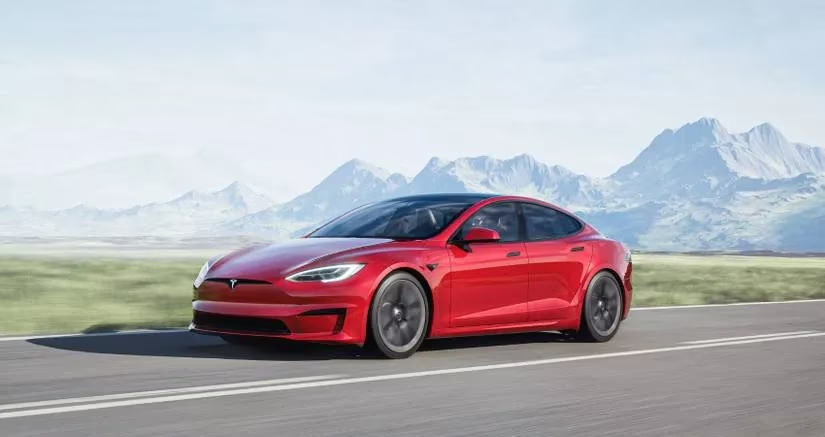
The CEO's voice, a familiar beacon from my speakers, called it merely a 'misleading term.' A 'virtual recall,' some legal scholar named it, a phrase as intangible as the update that was supposed to fix it all. With a tap on my screen, the Over-The-Air remedy arrived, silent and unseen. Yet, this new realm of law we are driving into—populated by deepfakes, conversational AIs, and my car's own uncertain judgment—feels untamed, a digital frontier where precedence is written in accident reports. My high safety score, earned through months of cautious driving, granted me access to this beta-test of the future. But the instructions were clear, a poetic contradiction: Be ever-vigilant while you relinquish control. Your hands must be ready to save you from the system you paid to trust. The final responsibility, the small print sings, remains mine alone.
I remember the stories that trickled out before the big recall—the spectral warnings of what could go wrong.
-
The Bagel & The Firetruck (2018): A driver, coffee in hand, autopilot engaged. A merge, a revelation of a parked truck, warnings ignored. A crash at 31 mph. Human and machine, a chorus of failure.
-
The Fatal Median (2018): Walter Huang's Model X, a sudden acceleration into concrete. Warnings unheeded, a battery breached, a life extinguished. The system said 'go' when everything screamed 'stop.'
-
The Rolling Stop (2022): Over 50,000 cars recalled because they forgot the fundamental law of the intersection: halt.
The National Highway Traffic Safety Administration has a ledger, now: three dozen investigations, nineteen souls lost where driver met digital assistant in a fatal misunderstanding. The company counters with its own epic metric—billions of miles traversed uneventfully. They argue the math favors the machine. But grief is not a statistic, and trust is not a data point. My faith is measured in the tightness of my grip on the wheel during an amber light.
What of the other promises shimmering on the horizon? The angular specter of the Cybertruck, still without a solid earth to roll upon. The FSD was to be the crown jewel, the feature that would redefine not just a car, but mobility itself. This recall, this ongoing public beta test conducted on public roads, has cast that jewel in a doubtful light. Will it make or break the future they've sold us?
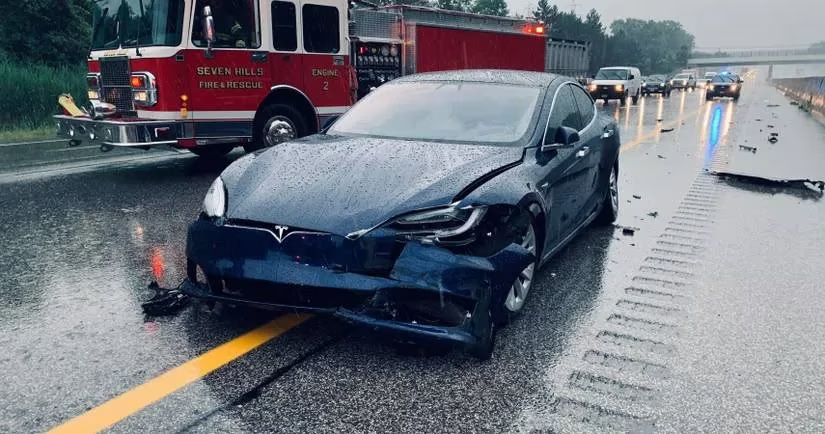
The market, that great and fickle beast, seemed to shrug. A 5.7% dip in stock, a recovery within a day. Financial faith, it seems, is more resilient than the trust I feel in my driver's seat. The recalled cars, mine included, remain on the road. No concrete date for a concrete fix, just the nebulous assurance of a software update already received. We are all participants in a grand, rolling experiment.
So here I sit, in 2026, navigating a world where my vehicle is both a marvel and a question. I am the first-generation pioneer of this autonomous dream, tasked with teaching the machine the poetry of human caution—the meaning of a full stop, the respect for a boundary line, the sacred pause of a yellow light. The road still calls, the electric hum is still a siren's song, but my journey is now a dialogue. I speak to the car through my alertness, and it replies with the silent, imperfect logic of its code. We are learning the rules of this new road together, one cautious, over-the-air-updated mile at a time.
Leave a Comment