
Mustang Mach-E: Ford's Electric Crossover That Still Haunts Purists in 2026
The Ford Mustang Mach-E redefines the electric crossover with bold styling, practical space, strong range, and performance beyond its controversial name.
In 2026, the Ford Mustang Mach-E is no longer the new kid on the electric block. It is a familiar sight in suburban driveways, school pick-up lines, and Whole Foods parking lots. But when it first appeared, the name alone caused coronary events among traditionalists. A Mustang four-door? An SUV? A silent electric cargo carrier wearing the pony badge? To some, that was not a car; it was a personal insult delivered on four wheels. Ford tried to justify the name with performance numbers. Purists responded with the 1965 Falcon 289 V8 argument: if stuffing a V8 into a Falcon made it a Mustang, Ford would have sold half a million Falcons. It did not. The original Mustang was style over utility, a sport coupe that launched a genre. So, the Mach-E is not a Mustang. Fine. Forget the name. Judge the machine.
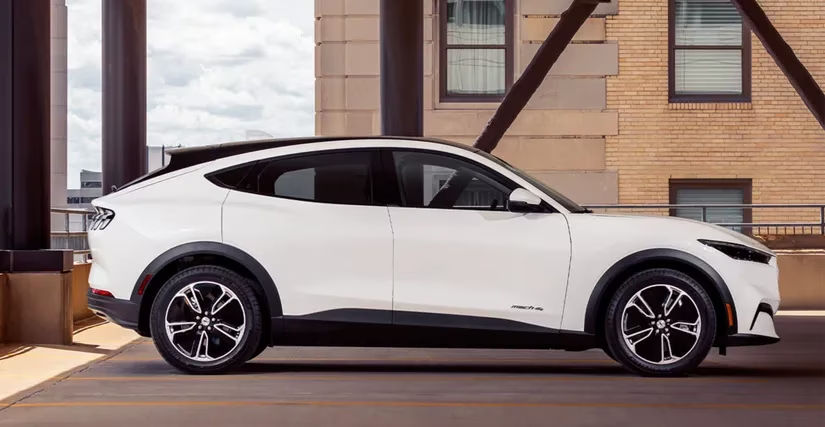
The Crossover That Wants to Be a Puppy
Ford's first from-the-ground-up EV was aimed at the heart of the market: the mid-size crossover. That means it can seat adults in the back or fold the seats for a major purchase at the home improvement store. Like a puppy, it can bounce around town for a good part of the day, but when it is down, it needs to sleep for hours. In 2021, its competitive set was tiny: Tesla Model Y, Volkswagen ID.4, and soon the Volvo XC40 Recharge. By 2026, that set is a rugby scrum. But the launch specs still explain why the Mach-E mattered.
With a starting price around $42,895, the Mach-E was more expensive than the essentially identically priced $39,990 Model Y and $39,995 ID.4. Factor in the $7,500 federal tax credit, and all three dipped below the average new car price. The Mach-E's 117-inch wheelbase was longer than the Model Y's 113.8 inches, though it was an inch shorter overall at 186 inches. The VW was noticeably smaller at 108.9 and 180.5 inches. Rear legroom was generous for all three: 38.1 inches for the Mach-E, 37.6 for the VW, and 40.5 for the Tesla. For context, a Mercedes S-Class offers just 34.1 inches. So yes, the Mach-E could carry actual humans in the back.
Range, Price, and the Trim Ladder
Since the first question about any EV is not how fast it goes but how far it goes, the Mach-E started with a 230-mile range. The Premium RWD with the Extended Range battery climbed to 305 miles. The Model Y had a 244-mile entry model and up to 326 miles. The ID.4 started at 234 miles. At the base level, they were fairly compatible. Here is how the 2021 Mach-E lineup broke down:
| Trim | Price | Drive | Battery | Range | 0-60 |
|---|---|---|---|---|---|
| Select RWD | $43,895 | RWD | 76 kWh SR | 230 mi | 5.8s |
| Select AWD | $46,595 | AWD | 76 kWh SR | 211 mi | 5.2s |
| California Route 1 | $49,800 | RWD | 99 kWh ER | 305 mi | 6.1s |
| Premium RWD | $47,000 | RWD | 76 kWh SR | 230 mi | 5.8s |
| Premium RWD ER | $52,000 | RWD | 99 kWh ER | 300 mi | 6.1s |
| Premium AWD | $49,700 | AWD | 76 kWh SR | 211 mi | 5.2s |
| Premium AWD ER | $57,400 | AWD | 99 kWh ER | 270 mi | 4.8s |
| GT | $60,500 | AWD | 99 kWh ER | 250 mi | 3.8s |
| GT Performance | TBD | AWD | 99 kWh ER | 250 mi | 3.5s |
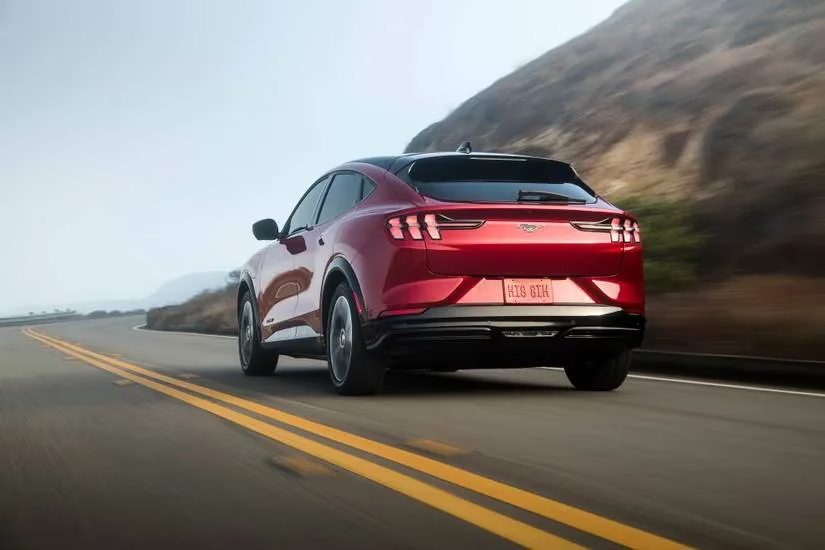
The Black-Box Powertrain Problem
EV powertrains are simple, yet inscrutable. There is no displacement, no cylinder count or configuration, no variable valve timing, no bore and stroke figures, no turbo boost pressure, no fuel injection type, and usually no transmission. None of the things car enthusiasts use to sense a drivetrain's character. You are told a motor's power stats and that is it. They are black-box powertrains. On EVs, you pay as much attention to the battery as the motor. The Select model came with a 76-kWh Standard Range battery or a 99-kWh Extended Range unit. For RWD models, the motor sat at the rear axle. AWD did not bother with driveshafts or differentials; Ford simply added another motor on the other axle and let electric signals balance the power.
EV batteries are heavy. A Premium AWD Mach-E with the Extended Range battery tipped the scales at 4,856 pounds. A marginally larger Ford Edge ST weighed almost 400 pounds less. The good news: the battery weight sat in the floor, which mitigated body roll and fore-aft heaving. The Mach-E was stable and fairly flat in turns for a crossover, but the weight was still apparent in sudden moves. Tossible it was not. The ride drifted into luxury territory thanks to its silence and road isolation.
Whisper, Engage, Unbridled, and One-Pedal Weirdness
The Mach-E came with three whimsically named drive modes: Whisper, which encouraged economy; Engage, which felt like a sport mode; and Unbridled, which responded more quickly to all driver inputs but could be a bit abrupt for everyday use. Another EV trick was one-pedal driving. Regenerative braking began as soon as you lifted off the accelerator and increased the more you lifted. It slowed the car enough to substitute for the brake pedal in most situations. How much you like this depends on how steady your foot is, but most reviewers gave it a thumbs up. MotorTrend went further, calling one-pedal braking fantastic and linear, stopping smoothly where you wanted it just about every time. With one-pedal mode off, the brakes were more inconsistent, a bit rubbery, and they did not manage the transition between regenerative and mechanical braking well.
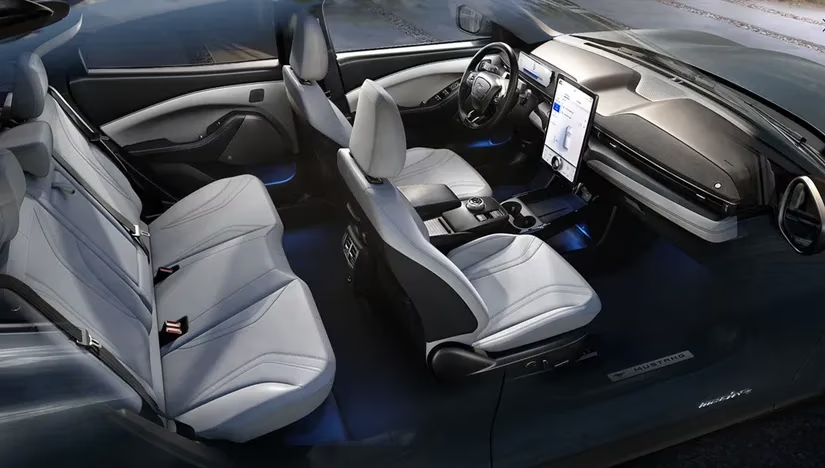
Interior, Cargo, and a Very Large Screen
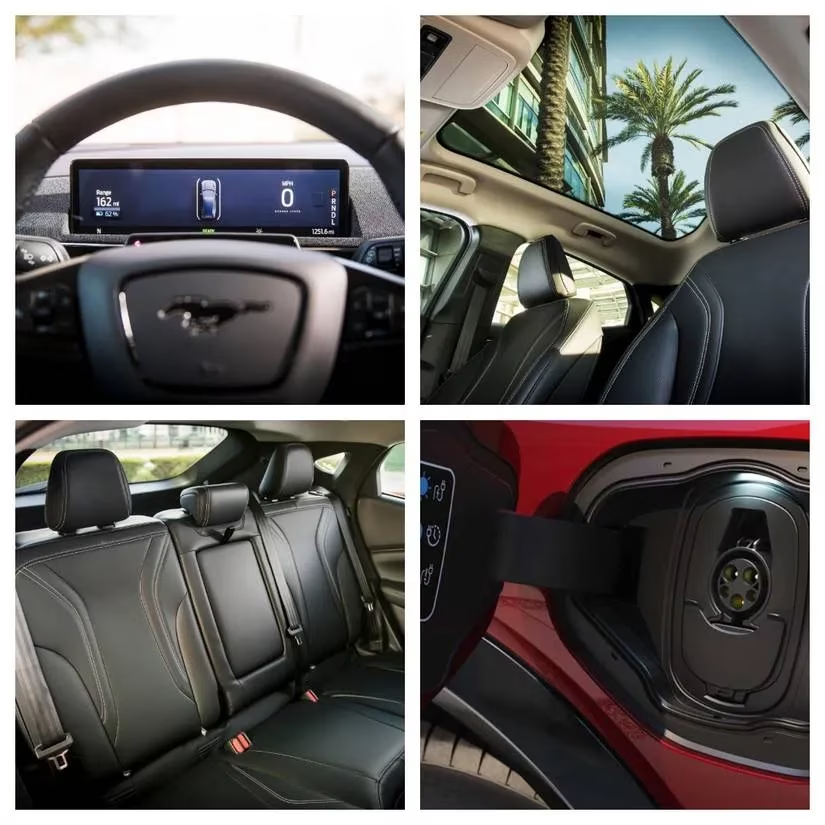
The Mach-E was about the size of a mid-size crossover. Except for a longer wheelbase, its dimensions fell about an inch or two shy of the Ford Edge and were close to the Tesla Model Y. There was 29.7 cubic feet of cargo space behind the rear seat and 59.7 with the seat down. Then there was the 4.8-cubic-foot frunk. The cabin was pleasant enough. Designers apparently could not figure out how to integrate the vertical 15.5-inch display screen, so they did not try. It just sat in front of an otherwise clean, if spartan, dash. Rear legroom was generous.
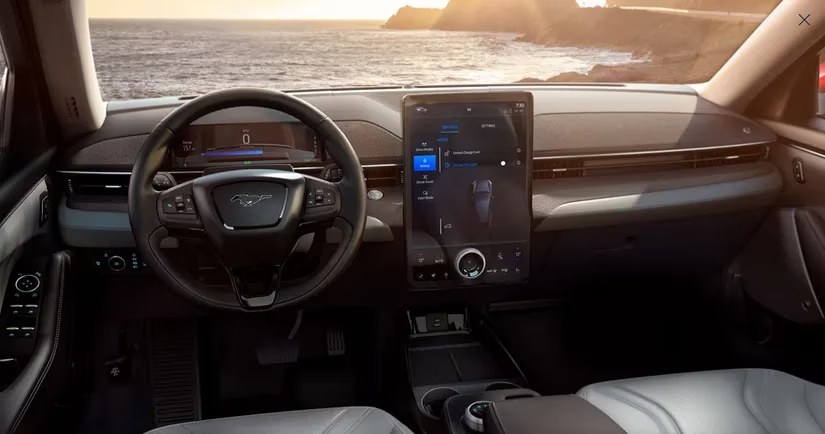
The huge screen ran the latest version of SYNC, including voice recognition for climate, audio, and navigation. Unlike Tesla, the Mach-E did not leave everything to the screen. At the bottom of the screen panel was a physical rotary selector and fixed climate controls. Thankfully, there was a digital driver's display visible through the steering wheel. Keyless push-button start, rain-sensing wipers, and a wireless phone charging pad were standard. The Phone as a Key system was just as it sounds, though Android users seemed to have trouble with it. All models were compatible with the FordPass Connect smartphone app, which allowed remote window and lock operation, charge status, and nearest charger location.
Safety Tech and Trim Highlights
All Mach-E models had Ford Co-Pilot360 2.0, which included:
-
Pre-Collision Assist with Automatic Emergency Braking
-
BLIS with Cross-Traffic Alert
-
Lane-Keeping System with Lane Centering
-
Auto High Beams
-
Reverse Sensing and Brake Assist
-
Intelligent Adaptive Cruise Control with Stop-and-Go
-
Speed Sign Recognition
-
Intersection Assist, which warned of obscured oncoming traffic during left turns
-
Evasive Steering Assist, which combined braking with evasive steering if pre-collision assist was insufficient
-
Post-Collision Braking, which engaged the brakes after airbag deployment to help prevent a secondary collision
The Select RWD used a rear-axle motor rated at 216 kilowatts, or 290 horsepower and 317 lb-ft of torque, all available from a standstill. Ford claimed 0-60 in 5.8 seconds. For the record, that matched a 1971 Mustang Boss 351. The AWD version kept the same horsepower but raised torque to 428 lb-ft, cutting 0-60 to 5.2 seconds, just quicker than a 1970 Mustang Boss 429. Range dropped to 211 miles. Inside, black ActiveTex cloth was the only choice. There was a six-speaker audio system with speed-compensating volume and three months of free Sirius XM. Outside, 18-inch gray aluminum wheels and sequential LED turn signals.
The Comfort/Appearance Package added heated front seats and steering wheel, driver-seat memory, a six-way manual passenger seat, a cargo area cover, a black painted roof, power-folding mirrors, a hands-free foot-activated power liftgate, and 19-inch shadow silver wheels.
The California Route 1 was RWD only but came standard with the Extended Range battery for an estimated 305 miles. Extra weight without extra traction slowed 0-60 to 6.1 seconds. It also had a fixed glass roof, a 360-degree camera, driver-seat memory, power-folding mirrors, and Active Park Assist 2.0, which could identify a parallel parking space and take over steering while the driver handled braking, acceleration, and gear changes.
The Premium model came with most Comfort/Appearance items, dropped the manual passenger seat adjustment, replaced the black roof with fixed glass, and used its own 19-inch wheel design. Key additions included a Bang & Olufsen 10-speaker sound system, a 360-degree camera, multicolor ambient interior lighting, Active Park Assist 2.0, and LED projector headlamps with auto high beams.
The GT and GT Performance
The GT arrived in late summer 2021. In Mach-E terms, GT meant the same as it did for real Mustangs. All GT models were AWD with the Extended Range battery. The motors generated 480 horsepower and a mind-boggling 600 lb-ft of torque. 0-60 was targeted at 3.8 seconds, with a targeted 250-mile range. The GT added 20-inch wheels, GT badging, red-painted brake calipers, pony projection lamps, and black side mirrors, but dropped the fixed glass roof. Inside were Sport Style Seats with ActiveX seating material, Miko inserts, copper metallic stitching, an aluminum applique instrument panel, and front door scuff plates with pony graphics and GT lettering. Because too much is never enough, Ford also promised a GT Performance Edition with 634 lb-ft of torque and a 3.5-second 0-60.
The Verdict in 2026
The Mach-E may not be a Mustang, but it was a very viable and attractive jump into the EV world. By 2026, it is one of many electric crossovers fighting for attention, and the original specs look almost quaint next to newer models. Yet the formula still works: useful range, generous rear legroom, a practical frunk, and enough torque to make passengers giggle. The name still annoys purists, and it probably always will. But the car itself does the job. Like most EVs, this was only just the beginning. The pony may be electric, but it still kicks.
Leave a Comment