
Life with a Hydrogen Fuel-Cell Car in 2026: A Gamer's Perspective on the EV Alternative
Hydrogen fuel-cell vehicles (HFCVs) offer a compelling and clean alternative to EVs, boasting instant refueling and impressive 400+ mile ranges. However, their widespread adoption is severely hindered by a fragile and sparse refueling infrastructure.
In the ever-evolving landscape of personal transportation, where electric vehicles (EVs) have captured the public's imagination and significant government investment, a quiet contender continues its journey on the fringes. For the professional gamer, accustomed to evaluating systems for efficiency, performance, and practical viability, the hydrogen fuel-cell vehicle (HFCV) presents a fascinating case study. It's a technology that promises the instant refueling of a gasoline car with the clean emissions of an EV, yet in 2026, its story remains one of immense potential locked behind formidable logistical challenges. While the world charges ahead with batteries, a small community of drivers, primarily in California, experiences motoring in its most elemental form: converting the universe's most abundant element into nothing but water vapor and forward motion.
The heart of the experience is the fuel cell stack itself, a piece of engineering that feels like it belongs in a sci-fi strategy game. 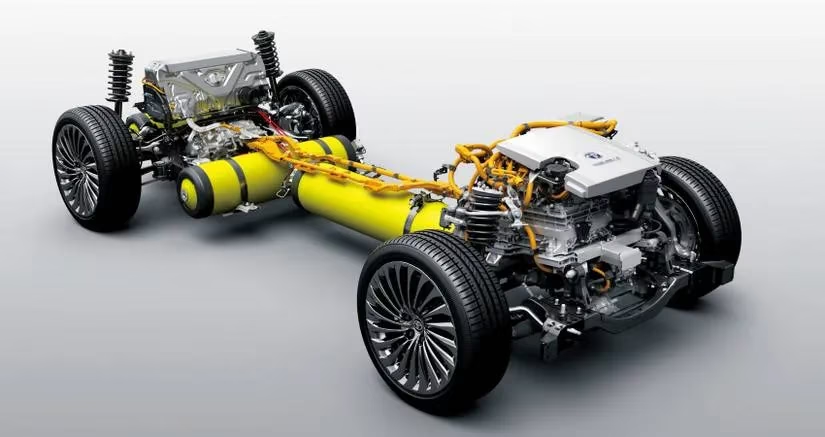 Unlike an EV's bulky battery pack, this system generates electricity on-demand through a chemical reaction. Pure hydrogen from the tank meets oxygen from the air, and the resulting energy powers an electric motor nearly identical to those found in Teslas or Lucids. The 'exhaust' is simply warm water vapor. For the performance-minded user, the driving dynamics are familiar: instantaneous torque, a single-speed transmission, and a serene, silent cabin. The real-world range of models like the Toyota Mirai comfortably exceeds 400 miles per tank, a figure that still makes many contemporary EVs envious.
However, this elegant engineering faces its greatest test not on the road, but at the refueling station. The refueling ritual is where the HFCV fantasy meets reality. It's a three-minute process, blissfully familiar to anyone who has ever pumped gasoline. Yet, this convenience hinges on a fragile and sparse infrastructure. In 2026, California remains the primary proving ground, with a network that has grown slowly but remains vulnerable.
The Infrastructure Hurdle: A Quest with Limited Save Points
Imagine a multiplayer game where the respawn points are scarce and occasionally vanish. That's the analogy for HFCV ownership. The 2019 incident, where an explosion crippled the Bay Area's hydrogen network, exposed the system's brittleness. Drivers were left stranded, forced into nocturnal fuel runs, with Toyota issuing lease refunds—a scenario unthinkable in the EV or ICE world. While stability has improved, the core issue persists: building a hydrogen station is a complex, costly endeavor compared to installing EV chargers. Stations can also require downtime to repressurize after a handful of fill-ups, creating unpredictable availability.
The Fleet in 2026: A Select Few Heroes
The roster of available HFCVs remains exclusive, akin to a curated selection of premium-game characters.
-
Toyota Mirai: The veteran champion, with over a decade of refinement. Its sleek design and refined driving experience make it the flagship.
-
Hyundai Nexo SUV: The versatile support class, offering crossover utility and advanced features.
-
Notable Absence: The Honda Clarity Fuel Cell, discontinued years prior, a reminder of the market's challenges.
Collectively, these models represent a niche but dedicated community. Their ownership is characterized by both the joy of cutting-edge, clean technology and the constant, low-level anxiety of 'range logistics' far more complex than any EV road trip.
The Pros and Cons: A Balanced Scorecard
Every gamer knows to weigh strengths against weaknesses before committing to a build. For HFCVs, the ledger is sharply divided.
| Advantage (The Pro Gamer Move) | Disadvantage (The Critical Weakness) | | :--- | :--- | | | ⚡ 3-5 Minute Refueling – Faster than charging even the fastest EV. | 🏭 Extremely Limited Infrastructure – Confined almost entirely to California. | | 🌍 Zero Tailpipe Emissions – Only water vapor exits the exhaust. | 💸 High Fuel Cost – Hydrogen remains expensive, often equating to $6-$9 per gallon of gasoline equivalent. | | 🛡️ Proven Safety – Carbon-fiber tanks are incredibly robust and have an impeccable safety record. | 🔋 Complex Production – Creating 'green' hydrogen requires vast renewable energy, making the well-to-wheel efficiency lower than a direct EV charge. | | 🚗 Long Range – Consistent 400+ mile range alleviates daily anxiety. | ⏳ Station Downtime – The need to repressurize can lead to temporary station closures. |
The financials are a crucial part of the strategy. Manufacturers like Toyota have long offered generous hydrogen fuel cards (e.g., $15,000 worth) with a new vehicle to offset the high cost. In 2026, these incentives remain critical, raising the question of long-term economic sustainability once the promotional fuel runs out.
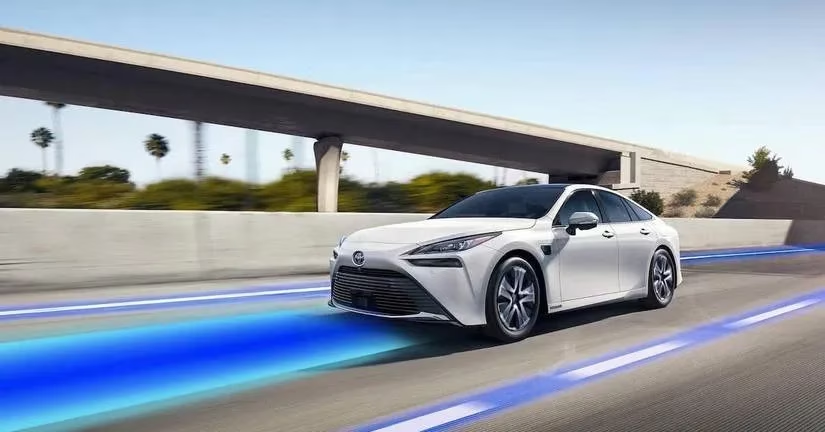 On the open highway, the HFCV experience is arguably superior to most. It combines the long-distance cruising ease of a gasoline car with the smooth, quiet power delivery of an EV. The Mirai glides along, its only output a faint plume of condensation on a cold morning—a tangible reminder of its clean operation. For the environmentally conscious driver who covers long distances and values time, this is the technology's sweet spot.
Yet, the verdict in 2026 is one of stalled momentum. The explosive growth of the EV charging network, coupled with rapid improvements in battery energy density and charge speeds, has widened the gap. Hydrogen's promise for trucks, buses, and industrial applications has garnered more investment than the passenger car segment. Owning an HFCV today is less about adopting the future of cars and more about participating in a live, large-scale beta test for a specific type of energy ecosystem.
For the professional gamer—someone who appreciates sophisticated technology, understands system dependencies, and doesn't mind navigating complex rules for a unique reward—the hydrogen fuel-cell car is a compelling side-quest. It offers a glimpse of an alternative timeline where filling stations dispense the future itself. But for the main campaign of global decarbonization, the EV has clearly captured the objective points, secured the resources, and built an overwhelming infrastructure advantage. The hydrogen car is no longer the 'next big thing'; it's a brilliant, beautiful, and beleaguered alternative, waiting for its network to render.
Leave a Comment