
Hyundai's $1.1 Billion Hydrogen Bet: Diversifying Beyond Battery Electric Vehicles for a Zero-Emission Future
In a bold counter-strategy to battery electric vehicles (BEVs), Hyundai is investing $1.1 billion to champion hydrogen fuel cell technology for commercial and heavy-duty transport, aiming for massive 100,000-unit annual production.
In a world where battery electric vehicles (BEVs) are capturing headlines and significant investment, Hyundai has made a bold and counterintuitive move, allocating a staggering $1.1 billion specifically for hydrogen fuel cell technology. While the Hyundai Motor Group, including its subsidiary Kia, continues its aggressive push into the BEV market, this massive capital injection signals a deeper, more diversified strategy. The question arises: why would a major automaker invest so heavily in hydrogen at a time when batteries seem to be winning the race? The answer lies in a fundamental belief that a one-size-fits-all approach to decarbonization is insufficient for the complex demands of global transportation and industry.
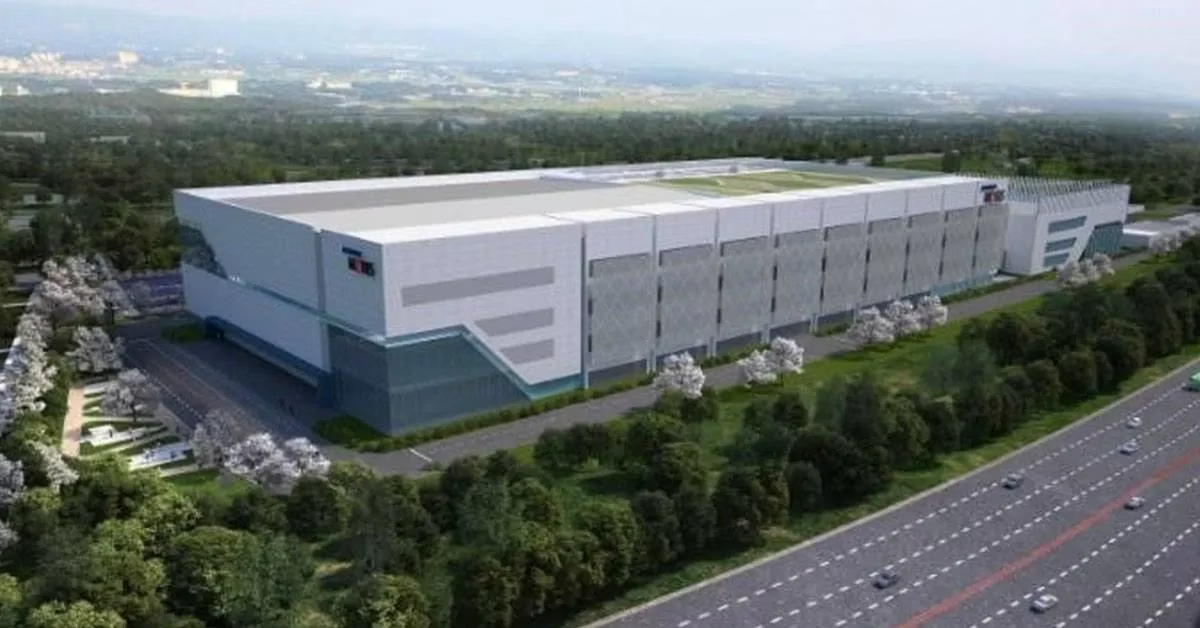
This strategic investment is being managed by Hyundai Mobis, the group's powerhouse for manufacturing automotive parts and components. The goal is ambitious: to transform Hyundai Mobis into the world's largest manufacturer of hydrogen fuel cell systems. This builds upon a foundation laid in 2018 when Hyundai established the industry's first integrated production line for fuel cell stacks and electronic control systems in Chungju, South Korea, with an annual capacity of 23,000 units. The new $1.1 billion will fund the construction of two additional state-of-the-art plants in Korea. The first is rising in the Cheongna International City Industrial Complex in Incheon, with a second facility slated for completion in the latter half of 2023. Once operational, this expanded network will empower Hyundai Mobis to produce an astonishing 100,000 hydrogen fuel cells annually, a scale intended to drive down costs and solidify technological leadership.
Why Hydrogen? The Case for Diversification 🚚⚡
The core rationale behind this gamble is that lithium-ion batteries, while excellent for passenger cars, face significant limitations in other critical sectors. Hyundai's leadership recognizes that different applications have vastly different needs.
-
Commercial and Heavy-Duty Transport: Long-haul trucking, freight carriers, and buses require rapid refueling and maximum uptime. The lengthy charging cycles of large battery packs are a major operational hurdle. A hydrogen fuel cell vehicle can be refueled in minutes, similar to a diesel truck, avoiding costly downtime.
-
Specialized Machinery: Imagine an emergency scenario where a construction vehicle or a forklift is needed immediately. A battery-powered machine might arrive with depleted charge, requiring a long wait before it can work. Hydrogen's quick refueling capability makes it far more suitable for demanding industrial and logistics applications where time is money.
Hyundai sees it as too risky to rely solely on battery technology. As the internal combustion engine era winds down, having a robust, zero-emission alternative for heavy industry is not just an option—it's a necessity for comprehensive carbon neutrality.
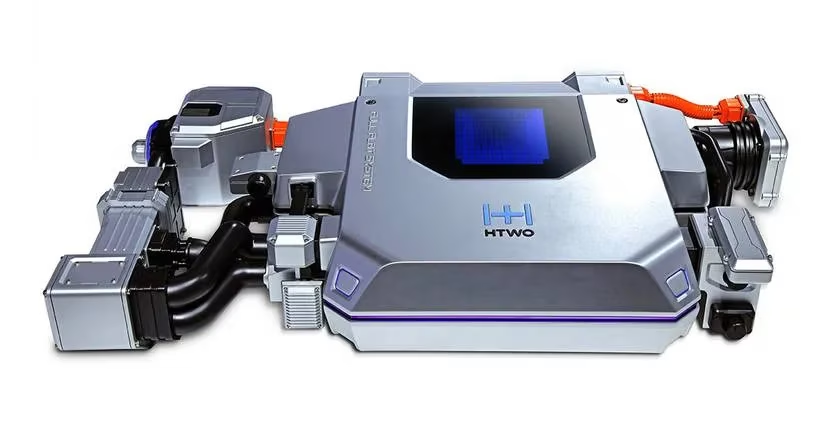
From Passenger Cars to a Hydrogen Ecosystem 🌊
Hyundai's hydrogen journey is not starting from zero. Following the discontinuation of the Tucson FCEV, the Hyundai NEXO remains the brand's flagship hydrogen fuel cell electric vehicle (FCEV), sold in regions with developing hydrogen infrastructure. More significantly, in 2020, Hyundai unveiled the XCIENT Fuel Cell, the world's first mass-produced, heavy-duty fuel cell truck, which is already being deployed in commercial fleets in Europe and North America.
The new investment is about scaling and diversifying far beyond passenger cars. Hyundai Mobis aims to become a supplier of hydrogen fuel cell systems to other businesses, targeting markets for:
-
Construction Machinery (e.g., excavators, loaders)
-
Logistics Equipment (e.g., port transporters, warehouse vehicles)
-
Marine and Rail Applications
-
Backup Power Systems
This vision was crystallized at Hyundai's inaugural "Hydrogen Wave" digital event in September 2021, where the company unveiled its grand plan to popularize hydrogen for "Everyone, Everything, and Everywhere" by 2040.
The Roadmap to 2040: A Hydrogen Society 🗺️
Hyundai has laid out a concrete technological and commercial roadmap. By 2023, the company plans to introduce a next-generation fuel cell system capable of generating up to 200kW of power. Concurrently, they project the cost of these systems will be halved, while their size will be reduced by 30%, making them more competitive and easier to integrate into various vehicle types.
The ambitions grow even larger:
| Target Year | Goal |
|---|---|
| 2028 | Convert Hyundai's entire commercial vehicle portfolio to hydrogen fuel cell powertrains. This would make Hyundai the first automaker to achieve this feat. |
| 2030 | Achieve price parity for Hydrogen FCEVs with Battery Electric Vehicles (BEVs). |
| 2040 | Realize a full "hydrogen society" where the technology powers not just transport, but also homes, buildings, and industry. |
At the Hydrogen Wave event, Hyundai showcased breathtaking concepts that hint at this future:
-
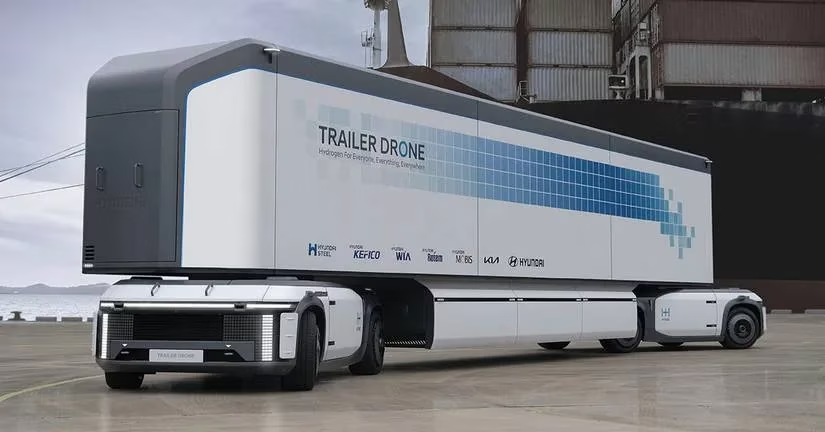
Trailer Drone: A fully autonomous, hydrogen-powered container transportation system boasting a remarkable 1,000km (621-mile) range.
-
Rescue Drone: A remotely operated, autonomous flying vehicle designed for life-saving missions in inaccessible areas.
-
Vision FK: Perhaps the most exciting, a high-performance hydrogen fuel cell hybrid sports car promising over 500kW (680 hp) and a 0-62 mph time under four seconds, with a range of 372 miles. This concept shatters the notion that hydrogen vehicles can't be thrilling.
While competitors like Toyota, BMW, and Mercedes-Benz are also exploring hydrogen pathways, Hyundai's $1.1 billion commitment is a decisive move to secure a leading position. The strategy is clear: don't just build hydrogen cars, but build the foundational technology that could power a broad swath of the zero-emission economy. By betting big on both batteries and hydrogen, Hyundai is positioning itself not merely as an automaker, but as a comprehensive provider of sustainable mobility and energy solutions for the world of 2026 and beyond.
Leave a Comment