
Hydrogen's Roadblock: Why Fuel Cell Cars Still Struggle in 2026
Hydrogen fuel cell vehicles and hydrogen cars promise zero emissions and revolutionary clean transport, yet face major adoption and production hurdles.
In the quest for clean transportation, hydrogen fuel cell vehicles (FCEVs) have long been heralded as a revolutionary solution. Utilizing the most abundant element in the universe, these vehicles promise zero tailpipe emissions, with water vapor as their only byproduct. Yet, as we stand in 2026, the vision of a hydrogen-powered automotive fleet remains more of a promise than a reality. Despite the technological elegance of fuel cells and the compelling environmental narrative, the mass adoption of hydrogen cars continues to lag far behind their electric vehicle (EV) counterparts. What are the fundamental hurdles that keep this seemingly perfect technology from taking over our roads?
At its core, a hydrogen fuel cell is a marvel of electrochemical engineering. The system operates silently and reliably, with no moving parts. Hydrogen gas enters the anode, where a catalyst splits its molecules into protons and electrons. The protons pass through a membrane to the cathode, while the electrons are forced through an external circuit, creating an electric current to power the vehicle's motor. At the cathode, these components reunite with oxygen from the air, forming pure water. This clean, on-demand electricity generation is the system's greatest strength. But is this elegant process enough to overcome the challenges that start long before the hydrogen reaches the car's tank?
🏭 The Hydrogen Production Puzzle
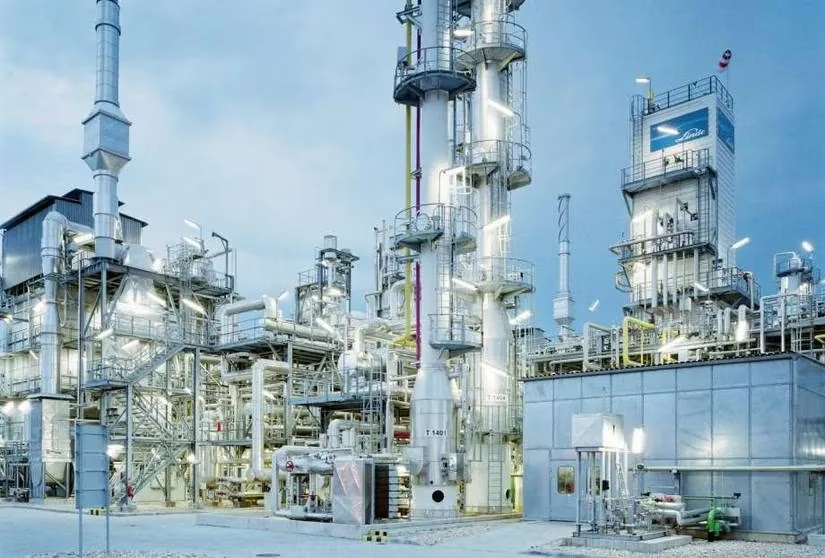
The first major obstacle lies in the very creation of the fuel itself. Hydrogen, while abundant, does not exist freely in nature; it must be extracted from other compounds. The dominant production method, even in 2026, remains steam methane reforming of natural gas. This process, while efficient and cost-effective, generates significant carbon dioxide emissions, undermining the green credentials of the resulting hydrogen. So-called "green hydrogen," produced via electrolysis using renewable electricity, offers a truly clean alternative. However, this method is energy-intensive and expensive. The overall energy cycle from source to wheel reveals a critical inefficiency.
Consider the journey of 100 units of renewable electricity:
-
Electrolysis: Converting this electricity into hydrogen gas is only about 75% efficient.
-
Compression & Transport: The hydrogen must then be compressed, chilled, and transported to a fueling station, a process roughly 90% efficient.
-
Reconversion in the Car: Inside the vehicle's fuel cell, converting hydrogen back into electricity is only about 60% efficient.
-
Motor Efficiency: Finally, the electric motor uses this power at about 95% efficiency.
When all these steps are combined, only about 38 out of the original 100 units of energy actually propel the vehicle. This starkly contrasts with battery electric vehicles, where the same 100 units of renewable power, after grid transmission and battery charging losses, can deliver over 75 units to the wheels. This fundamental energy vector problem means hydrogen FCEVs require more than double the primary energy input compared to a direct battery EV for the same distance traveled.
⛽ The Infrastructure Chasm
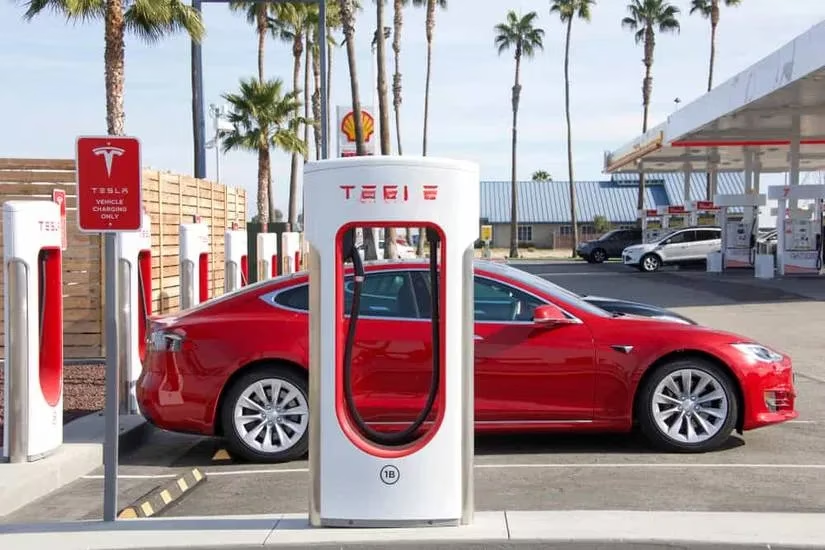
Perhaps the most visible barrier for consumers is the glaring lack of refueling infrastructure. While EV charging stations have proliferated into the hundreds of thousands globally, hydrogen refueling stations remain scarce, numbering only in the low hundreds worldwide. For a potential buyer, the "range anxiety" associated with finding a hydrogen pump is a significant deterrent. Building a nationwide network of hydrogen stations requires colossal investment, and with EV infrastructure expanding rapidly, the business case becomes increasingly difficult to justify. Furthermore, the cost of hydrogen fuel itself remains high, averaging well over double the cost-per-mile of electricity for an EV.
⚡ The Unstoppable EV Juggernaut
The competitive landscape has shifted dramatically. Battery electric vehicles have achieved what hydrogen cars have not: mass-market acceptance and exponential sales growth. By 2026, annual global EV sales are measured in the tens of millions, while FCEV sales struggle to reach even fifty thousand. Key EV advantages have solidified:
| Factor | Battery Electric Vehicles (BEVs) | Hydrogen Fuel Cell Vehicles (FCEVs) |
|---|---|---|
| Energy Efficiency | Very High (75%+ well-to-wheel) | Low (~38% well-to-wheel) |
| Refueling/Charging Network | Extensive & Growing Rapidly | Extremely Sparse |
| Vehicle Cost | Decreasing, aided by falling battery prices | High, due to expensive fuel cell systems |
| Fuel Cost per Mile | Low | High |
| Consumer Choice | Dozens of models across all segments | Handful of models (e.g., Toyota Mirai, Hyundai Nexo) |
The dramatic and sustained drop in lithium-ion battery costs has erased a former EV disadvantage, making them affordable for a much wider audience. Meanwhile, the high cost of fuel cell stacks and hydrogen storage tanks keeps FCEV prices elevated.
🔮 Is There a Future for Hydrogen on the Road?
Does this mean the dream of hydrogen cars is dead? Not necessarily. The technology may yet find its niche. Many experts in 2026 believe hydrogen's future in transportation lies not in passenger cars, but in heavier-duty applications where the drawbacks are less critical and the advantages more pronounced. Long-haul trucking, shipping, and perhaps rail transport are sectors where hydrogen's fast refueling time and high energy density could be decisive advantages over current battery technology. For the average commuter, however, the combination of superior efficiency, lower operating costs, and ubiquitous infrastructure makes the battery electric vehicle the clear and dominant choice for a sustainable personal transportation future. The hydrogen passenger car, it seems, remains a technology perpetually waiting for its moment to arrive.
Leave a Comment