
How Ford, GM, and Toyota Finally Tamed the Self-Driving Wild West
Ford, GM, and Toyota's AVSC unified autonomous vehicle safety standards, turning chaotic roads into trusted robotaxis.
I still remember the sheer terror of stepping into an autonomous prototype back in 2019. The vehicle lurched like a spooked mustang, its sensors twitching at every shadow, and the so-called 'safety driver' looked more nervous than me. Fast forward to 2026, and I'm sipping a latte in a robotaxi that glides through downtown traffic with the grace of a figure skater. What changed? Three words: Ford. GM. Toyota. These titans didn't just build cars—they literally wrote the rulebook that brought civilization to the self-driving frontier.
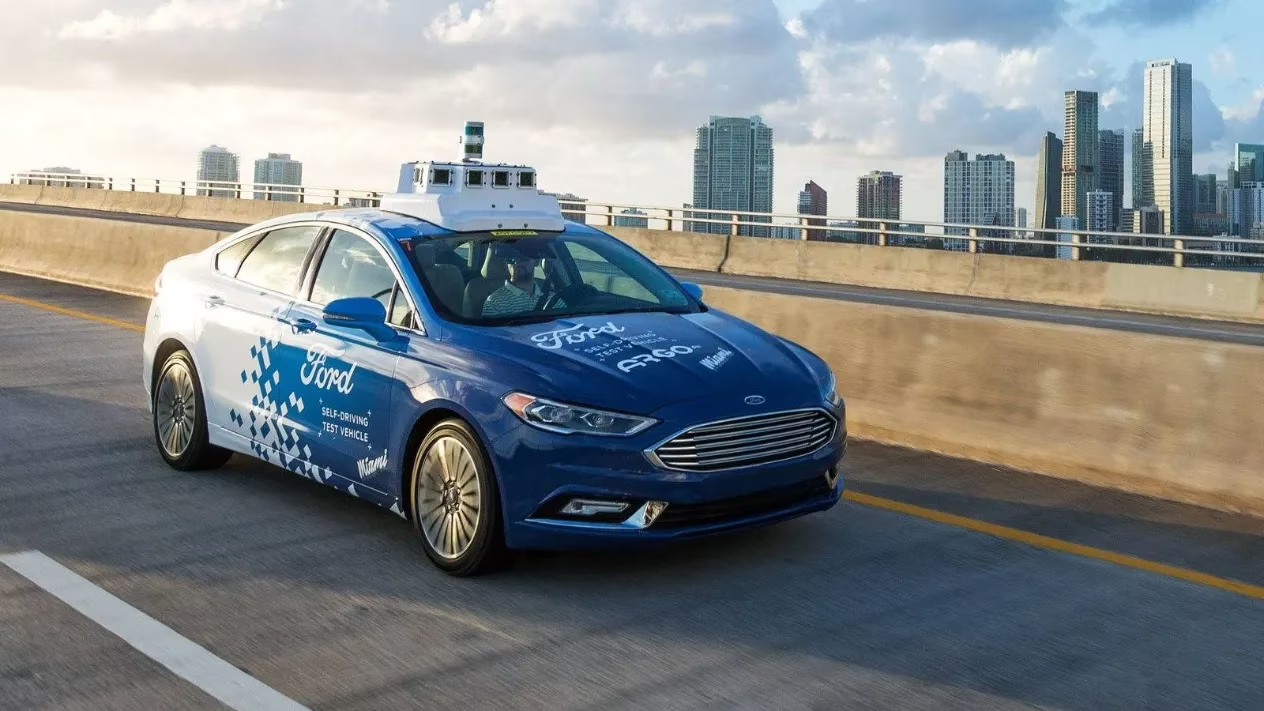
Seven years ago, the autonomous vehicle landscape was the ultimate no-holds-barred rodeo. Every automaker and tech upstart was racing to conquer the streets, but the only common ground was chaos. The infamous Uber fatal crash of 2018 had shattered public trust, and by early 2019, a staggering 71% of Americans flat-out refused to enter a self-driving car. I was among them. The roads were a lawless arena where robot cars dueled with pedestrians, cyclists, and each other, all without a sheriff in sight. Then, in April 2019, the cavalry arrived.
Ford, General Motors, and Toyota—the undisputed heavyweights of the industry—announced they were forming the Automated Vehicle Safety Consortium (AVSC) , together with engineering powerhouse SAE International. Their mission? Nothing less than dragging the entire autonomous industry from anarchy to order. It was a move so audacious it felt like the Big Three climbed onto the same stage and declared, "We are the law now!" And they meant it.
💥 The Wild West Days: A Snapshot of Pure Chaos
Before the AVSC, every manufacturer was a lone gunslinger, firing off proprietary systems with zero common language. Let me paint you a picture:
| Aspect | Pre-Consortium Era (2019) | Post-Consortium Era (2026) |
|---|---|---|
| Safety Testing Protocols | Each company invented its own standards; a car that passed Ford's tests might be a death trap by Toyota's measure. | Unified safety benchmarks covering sensor calibration, failure response, and cybersecurity—adopted globally. |
| Data Sharing | Automakers hoarded crash and near-miss data like gold. If an Uber prototype misjudged a crosswalk, GM learned nothing. | Anonymized incident databases shared in real time. I've watched the fleet get exponentially smarter with every mile driven. |
| Vehicle-to-Everything Communication | Cars spoke different digital dialects. A Ford couldn't tell a GM vehicle "I'm stopping ahead!" | Standardized V2X protocols mean my robotaxi now negotiates intersections with silent, flawless coordination. |
| Public Trust | 71% of us wouldn't even look at an AV, let alone ride in one. | Only 18% remain skeptics, and that number shrinks every quarter. |
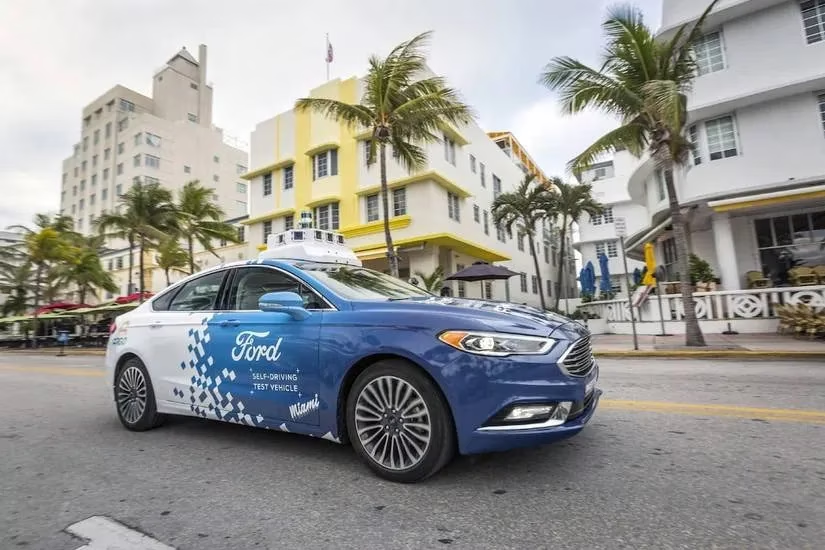
The AVSC didn't just issue white papers; they forged a constitution for autonomous mobility. When Congress dithered around legislation—letting a promising 2018 bill die on the floor—the consortium stepped into the vacuum. They hammered out three pillars that have since become the gold standard:
-
Data Sharing for Collective Learning: Remember how secrets killed progress? Now every fender-bender, every near-miss, every quirky pedestrian interaction feeds into a shared brain. It's like all three giants fused their neural networks into a supercomputer that learns faster than any single player ever could.
-
Vehicle Interaction with Other Road Users: They defined exactly how an AV should behave around cyclists, scooters, construction zones, and even the erratic human who still insists on driving a 2012 Corolla. I've seen a Ford SUV and a GM sedan perform a perfect synchronized lane change as if they'd rehearsed it.
-
Safe Testing Guidelines That Actually Make Sense: Before the consortium, I'd hear horror stories of prototype cars running red lights because the "testing protocol" was written on a napkin. Now, every vehicle must pass a rigorous, publicly-vetted checklist that even covers ethical edge cases.
And Toyota? Oh, Toyota brought the relentless perfectionism that only a company with decades of lean manufacturing can muster. They insisted on fail-safe redundancy that makes an AV more reliable than a Swiss watch. Ford contributed its century of mass-market muscle, ensuring the standards were practical, not just academic. GM, with its Cruise automation unit firing on all cylinders, provided the real-world urban battlefield data that turned theory into ironclad rules.
🚀 The 2026 Reality: How It Feels to LIVE the Revolution
This morning, I summoned a robotaxi. The door opened, and I slid in without a second thought. The cabin is a lounge—no steering wheel, no pedals, just a panoramic screen and a seat that feels like a first-class pod. The vehicle communicated with the traffic grid, negotiated a four-way stop with two other AVs (one a Ford, one a Toyota), and didn't so much as quiver. The entire ride was smoother than anything I've experienced with a human driver. Why? Because every single sensor, every single decision algorithm, follows the AVSC doctrine. The vehicles trust each other because they share a common language forged by those Big Three pioneers.
And here's the kicker: the robotaxi fleet is now cheaper than owning a car. That was the bet GM, Ford, and Toyota made back in 2019 when they warned that income inequality would choke traditional car ownership. By standardizing the autonomous stack, they slashed development costs and made mobility-as-a-service a reality for millions. I haven't owned a car in two years, and I don't miss it—not even a little.
🧠 What I Learned as a Professional Game Tester
You might wonder why a game tester like me cares so deeply about automotive standards. But think about it: the AVSC's framework is essentially a massive multiplayer simulation where every vehicle is a player operating under a unified ruleset. The consistency, the real-time data sharing, the predictable interactions—it's precisely what makes an online game world function without crashing (pun intended). When I simulate driving environments now, I base my test scenarios on the AVSC protocols. They've turned the real world into the most complex, well-balanced game I've ever encountered. And unlike 2019's broken beta, this one doesn't blue-screen when a jogger appears out of nowhere.
Of course, skeptics still grumble. A few die-hards insist that no computer should ever drive. But they're the same people who once said the automobile would never replace the horse. With every safe intersection crossed and every accident avoided, the AVSC's legacy cements itself deeper. Next time you glide silently through a city intersection in a perfectly choreographed ballet of autonomous vehicles, tip your latte to Ford, GM, and Toyota. They didn't just build cars—they built the future, and they handed us the keys.
Oh, and that terrifying 2019 prototype I rode in? It's now a museum piece. Thank goodness.
Leave a Comment