
Ford's Active Drive Assist for Mustang Mach-E: A Deep Dive into the Hands-Free Highway Tech
Ford Active Drive Assist and Mustang Mach-E set a new standard in hands-free highway driving, blending innovation with safety-focused technology.
The race towards autonomous driving is heating up, and Ford is throwing its hat into the ring with a significant new offering. The automaker has confirmed that its upcoming hands-free highway driving system, dubbed Active Drive Assist, will debut on the all-electric Mustang Mach-E by the end of 2021. This technology, part of Ford's broader Co-Pilot360 suite, represents a major step for the Blue Oval, positioning it as a direct competitor to established systems like General Motors' Super Cruise. Initially exclusive to the Mach-E, the system is expected to roll out to other models in Ford's lineup, with industry watchers eyeing the next-generation F-150 as a likely candidate. The feature will be delivered via an over-the-air software update, showcasing Ford's commitment to a more connected, updatable vehicle architecture—a move straight out of the Silicon Valley playbook.
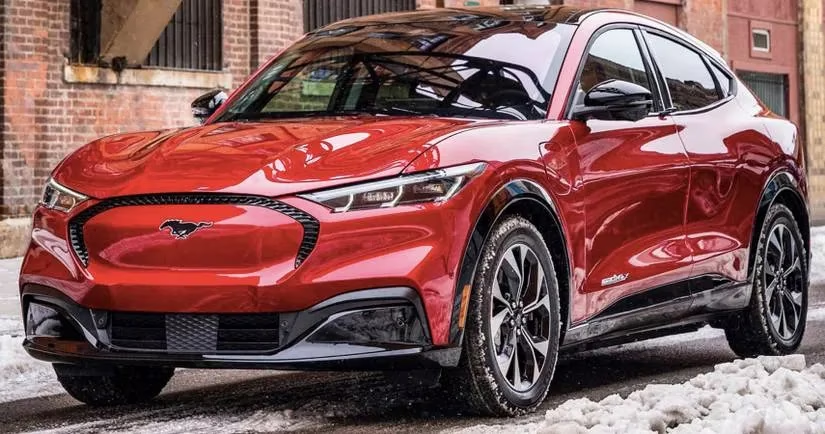
At its core, Active Drive Assist is designed to handle the vehicle's steering, acceleration, and braking on specific pre-mapped divided highways. Utilizing a combination of cameras, radar sensors, and detailed GPS mapping data, the system will be operational on over 100,000 miles of highways in the United States and Canada. This reliance on pre-mapped roads is a key differentiator, placing Ford's tech firmly in the camp of Cadillac's Super Cruise rather than Tesla's Autopilot, which famously uses a vision-based approach without such maps. The pre-mapping allows for greater precision and confidence, especially in complex situations like construction zones or faded lane markings.
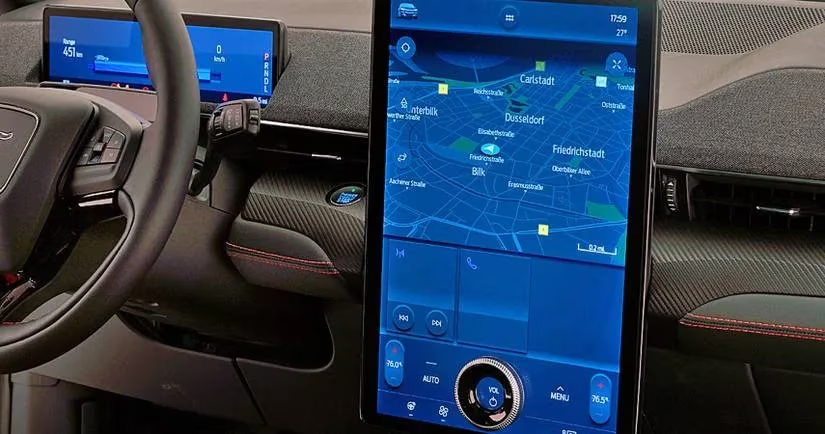
A crucial safety component, and another point of similarity with Super Cruise, is the inclusion of an infrared driver-facing camera. This tech monitors the driver's head position and eye gaze to ensure they are paying attention to the road ahead, even while the system is in control. If the camera detects driver inattention, a series of escalating alerts—from visual and audible warnings to seat vibrations—will prompt the driver to retake control. This is a different philosophy from Tesla's approach, which primarily relies on detecting torque (a light touch) on the steering wheel. Ford's team, led by Global Director of Battery Electric Vehicles Darren Palmer, emphasizes that clear communication with the driver is paramount for building trust in the system. "We think this is very important for building confidence," Palmer noted, stating that all Active Drive Assist information and status will be communicated clearly through the vehicle's digital cockpit screen.
Looking ahead to 2026, Ford's Active Drive Assist is expected to be a cornerstone of its advanced driver-assistance strategy. The system's capabilities will likely have evolved through successive over-the-air updates, potentially expanding its operational domain or introducing new convenience features. While official pricing for the optional package was not disclosed at launch, industry analysis suggested it would be competitive, likely falling closer to Cadillac's $2,500 Super Cruise package than Tesla's more expensive Full Self-Driving option. For consumers, this represents a more accessible entry point into the world of legitimate hands-free highway driving.
Key Features & Comparisons at a Glance:
| Feature | Ford Active Drive Assist | Cadillac Super Cruise | Tesla Autopilot (Basic) |
|---|---|---|---|
| Core Function | Hands-free on mapped highways | Hands-free on mapped highways | Lane-keeping & adaptive cruise (hands-on) |
| Operational Domain | 100k+ miles of US/Canada highways | 200k+ miles of US/Canada highways | Any marked lane |
| Driver Monitoring | Infrared camera (head/eye tracking) | Infrared camera (head/eye tracking) | Steering wheel torque sensor |
| Mapping Requirement | ✅ Yes, pre-mapped LiDAR data | ✅ Yes, pre-mapped LiDAR data | ❌ No |
| Delivery Method | Over-the-air update | Factory-installed | Software package |
In the grand scheme of things, Ford's move is a clear signal that the era of the 'co-pilot' is here. It's not about full autonomy yet—that's still a ways off—but about providing a smooth, confidence-inspiring experience on long, monotonous highway stretches. The Mustang Mach-E, as the launch vehicle, is the perfect poster child for this tech, blending Ford's performance heritage with a cutting-edge electric and software-driven future. As other automakers scramble to catch up, systems like Active Drive Assist are becoming a major battleground, a must-have feature that can make or break a vehicle's appeal in an increasingly tech-savvy market. It's no longer just about horsepower; it's about compute power and the sophistication of the code running behind the scenes.
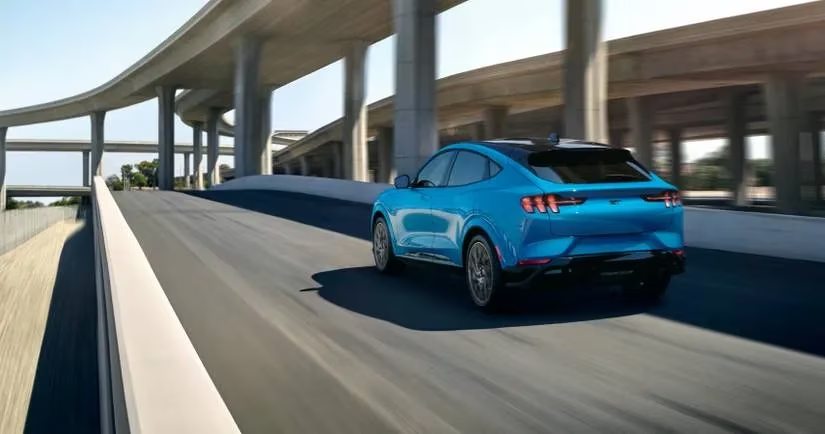
So, what does this mean for the average driver? In short, a less stressful commute. Imagine hitting the interstate, activating Active Drive Assist, and letting the car handle the tedious task of maintaining lane position and a safe following distance—all while you stay engaged and ready to intervene if needed. It's a game-changer for road trips and daily grind alike. As we move through the mid-2020s, the refinement and adoption of these systems will only accelerate, making what once seemed like science fiction a standard part of the driving experience. Ford's bet is that by offering a robust, safety-first system at a competitive price, they can win over consumers and solidify their position in the new era of automotive tech. Only time will tell if this strategy pays off, but one thing's for sure: the future of driving is looking increasingly hands-off.
Leave a Comment