
Ferrari's Electric Ambition: Steering Toward 2030 Without Autonomous Driving
Ferrari's electric vehicles and electrification strategy mark a bold, strategic pivot, redefining high-performance luxury with a commitment to thrilling, driver-centric innovation.
The automotive landscape is undergoing a profound metamorphosis, and even the most iconic marques are not immune to the winds of change. Once a bastion of roaring internal combustion engines, Ferrari, the legendary Italian luxury car manufacturer, has officially joined the global shift toward electrification. While the industry pivots, with brands like Jaguar, Alfa Romeo, and Mercedes-Benz pledging all-electric futures by 2030, Ferrari's journey is charting its own unique course—one that embraces battery power while staunchly rejecting autonomous driving. The Prancing Horse is not merely following a trend; it is redefining what performance and passion mean in an electrified era, promising that its forthcoming electric vehicles will deliver excitement on par with their legendary predecessors.
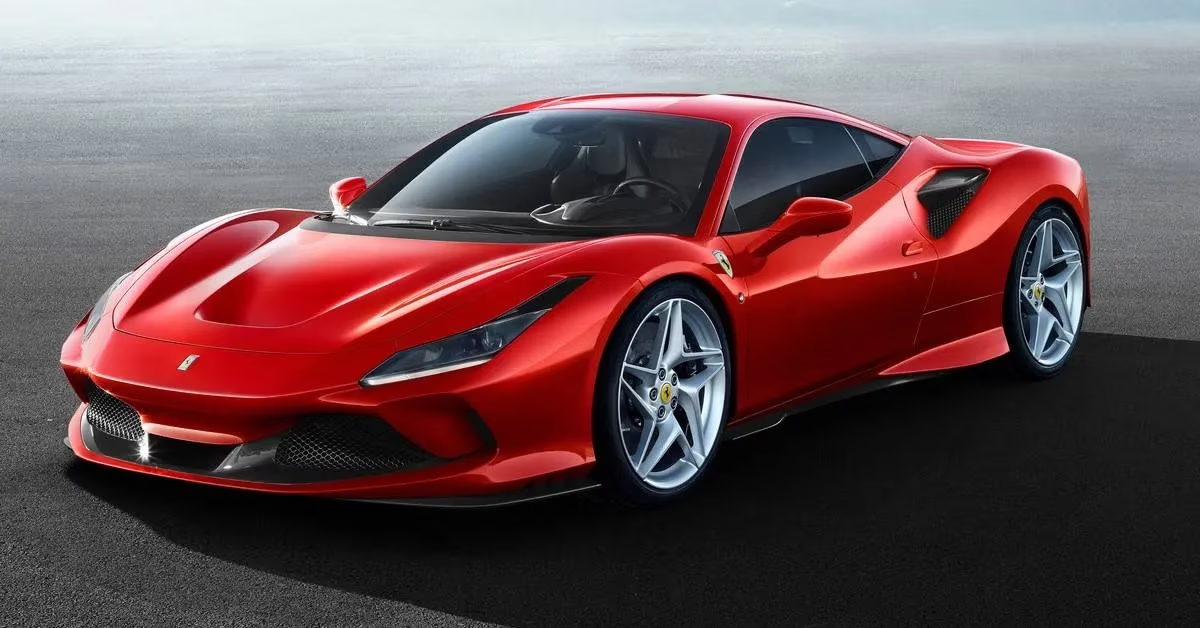
Ferrari's Electrified Roadmap: A Strategic Pivot
The shift is not a tentative experiment but a full-scale strategic offensive. Ferrari has committed a colossal investment, approximately $4.6 billion, to transform its historic factory in northern Italy into a dedicated hub for battery-electric vehicle (BEV) production. This financial commitment underscores the brand's serious intent to accelerate its electrification timeline. The corporate objective is clear: by 2026, a remarkable 60% of Ferrari's production output will consist of electrified models, encompassing both pure electric vehicles (EVs) and hybrid powertrains. This aggressive target is part of a broader product onslaught, with plans to launch 15 new models by the same 2026 deadline.
The brand's sustainability program, prominently featured on its official portal, publicly commits to achieving carbon neutrality across its entire value chain by 2030. This ambition necessitates sweeping changes, not just in powertrain technology but across manufacturing, materials sourcing, and design philosophy. The future Ferraris will inevitably incorporate more cutting-edge, high-end technology than ever before, but always in service of the driving experience.
The Purosangue Prelude and The First Pure EV
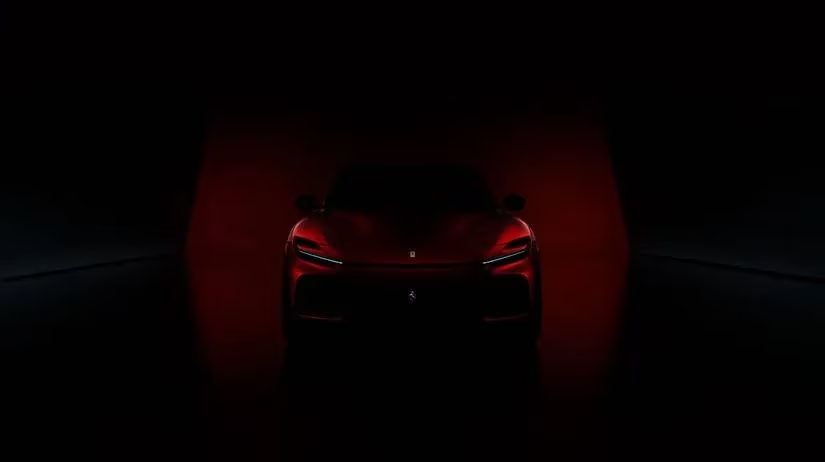
A tangible symbol of this new direction is the highly anticipated Ferrari Purosangue, the brand's first-ever crossover SUV. After years of speculation, its debut marked a pivotal moment. Contrary to early predictions of a hybrid V6, the Purosangue launched with a formidable, naturally aspirated V12 engine—a decision that reassured purists about Ferrari's commitment to emotional performance, even in a new vehicle category. While details on its exact power and performance were initially scarce, its arrival signaled Ferrari's willingness to expand its portfolio while maintaining core engineering values.
However, the true milestone awaits: Ferrari's first pure battery-electric vehicle, slated for reveal. This model will be the ultimate test of the brand's pledge to make electric cars "every bit as exciting" as their internal combustion forebears. The development of this vehicle is at the heart of the multi-billion-euro factory transformation, aiming to prove that electrification and exhilaration are not mutually exclusive.
The Human Element: Why Ferrari Draws the Line at Self-Driving
Amidst this whirlwind of electric innovation, one boundary remains unequivocally firm. Under the leadership of CEO Benedetto Vigna, Ferrari has declared autonomous driving technology a forbidden frontier. This is not a temporary stance but a philosophical cornerstone. In an interview, Vigna articulated the brand's ethos with crystalline clarity: “No customer is going to spend money for the computer in the car to enjoy the drive. The value of the man, of the human at the center, is fundamental.”
This principle positions Ferrari in stark contrast to competitors like Tesla and Volkswagen, who are aggressively pursuing fully autonomous capabilities. For Ferrari, the car is an instrument of engagement, a conduit for skill and sensation. The act of driving—the tactile feedback through the steering wheel, the precise modulation of throttle and brake, the connection between human intention and mechanical response—is the product's very soul. Removing the driver from that equation is seen as negating the core value proposition.
A telling anecdote from Vigna highlights this conviction. He recounted how a team of artificial intelligence experts once visited Maranello to lobby for autonomous driving systems. After experiencing a few laps on the track in a Ferrari, their perspective shifted entirely. “When they got out from a Ferrari they told me, OK Benedetto, our presentation is useless,” Vigna recalled. The visceral, immersive experience of piloting a Ferrari firsthand rendered their arguments moot; it was a powerful testament to the irreplaceable thrill of human-controlled performance.
Technology on Ferrari's Terms: Assistance, Not Autonomy
Ferrari's rejection of self-driving does not equate to a rejection of technology. Prospective owners can and should expect the latest in advanced driver-assistance systems (ADAS). These systems are designed to augment the driver's capabilities, not replace them. Features likely to be prevalent in future Ferrari EVs include:
-
Advanced Stability and Traction Control: Sophisticated systems that manage the immense torque of electric motors for optimal grip and handling.
-
Regenerative Braking Systems: Highly tuned systems that recover energy while providing intuitive pedal feel.
-
Adaptive Suspension and Aerodynamics: Real-time adjustments to ride height, damping, and active aero elements for supreme stability and agility.
-
Predictive Vehicle Dynamics: Using data and sensors to preemptively adjust systems for upcoming corners or road conditions.
-
Connectivity and Telemetry: Advanced systems for tracking performance data, vehicle diagnostics, and seamless integration with digital ecosystems.
The key differentiator is that these technologies will serve as a co-pilot, enhancing safety and performance, while ultimate control remains firmly, and joyfully, in the hands of the driver.
The Future Soundtrack: Emotion in the Electric Age
A significant challenge and opportunity for Ferrari's electric future lies in the acoustic dimension. The scream of a high-revving V12 or the bark of a turbocharged V8 is an intrinsic part of the brand's sensory signature. Engineers are undoubtedly investing heavily in creating an equally compelling aural experience for their EVs. This could involve synthesized sounds that respond to throttle input, enhance spatial awareness, and provide emotional feedback, ensuring the cabin experience remains visceral and engaging, even without traditional engine notes.
Conclusion: A Distinct Path Forward
As the automotive world accelerates toward an electric and increasingly automated future, Ferrari is navigating its own distinctive route. The brand is wholeheartedly embracing electrification as the next frontier of performance, investing billions to ensure its electric vehicles deliver the extreme emotions its clients expect. Yet, it is simultaneously making a bold, values-driven stand by excluding self-driving technology. In Ferrari's vision, the car remains a machine to be mastered and enjoyed, a symbol of human passion and skill. For a significant segment of enthusiasts who cherish the art of driving itself, this commitment to the "human at the center" is not a limitation, but the very essence of the brand's enduring allure. The coming years will reveal how this philosophy translates into the tangible, electrifying reality of Ferraris gliding silently—but never autonomously—down the road.
Leave a Comment