
A Whisper of Hydrogen: My Journey with the Mirai in 2026
Toyota Mirai and hydrogen fuel cell vehicles offer a pioneering, eco-friendly alternative to battery electric cars, emitting only pure water.
In this age of silent electric hums, where the road has become a canvas for electrons, I chose a different path. While the world accelerated into the realm of batteries, I felt a quiet pull towards a more ethereal element. My companion is the Toyota Mirai, a vessel powered not by stored lightning, but by the most abundant substance in the universe: hydrogen. It is a solitary journey, a testament to a vision that began not today, but decades ago, in 1992, when Toyota first saw the glimmer of possibility in a fuel cell. In 2026, as I glide silently through the city, the Mirai feels less like a relic of a forgotten future and more like a quiet pioneer, whispering secrets of a road less traveled.

The Alchemy of Motion: How My Mirai Breathes
This machine, my Fuel Cell Electric Vehicle (FCEV), is a marvel of modern alchemy. It does not simply carry energy; it conjures it from the very air we breathe. Within its sleek frame lies a heart unlike any other. The process is one of elegant simplicity:
-
Intake: Hydrogen, stored in high-pressure tanks, meets oxygen drawn from the surrounding atmosphere.
-
Reaction: Inside the fuel cell stack, a serene electrochemical dance occurs, stripping electrons from the hydrogen atoms.
-
Creation: This flow of electrons is harnessed as clean electricity, powering the motor that turns the wheels.
-
Emission: The only byproduct of this entire symphony? Pure, clean water vapor. Toyota even claims it cleans the air as it moves, a notion of "minus emissions" that turns every drive into a small act of environmental restoration. The water expelled is so pure it's often said to be drinkable—a poetic, if impractical, testament to its cleanliness.
The Solitary Path: A Landscape Dominated by Electrons
My journey, however, is a solitary one. The automotive landscape of 2026 is overwhelmingly painted in the hues of battery-electric vehicles (BEVs). The statistics from just a few years back tell a stark tale: in 2022, while nearly 800,000 BEVs found homes in the U.S., only a whisper over 2,700 hydrogen vehicles were sold. On the road, I am an anomaly. My Mirai and its rare sibling, the Hyundai Nexo, are islands in a sea of Teslas, Rivians, and electric offerings from every major automaker. The chorus for electrification grows louder each year, with even performance icons like Dodge announcing their electric strategies.
Yet, the dream of hydrogen is not extinguished. It flickers in the workshops of visionaries. Porsche whispers of hydrogen engines that could rival their legendary V8s. BMW, in partnership with Toyota, has its gaze set on a market-ready hydrogen SUV by the end of this decade. This is not a dead end, but a parallel path, waiting for its moment to converge.

The Whispered Advantages: Why I Continue This Journey
I remain on this path because of the profound promises hydrogen fulfills, promises that even in 2026, make me pause and consider the broader horizon.
-
The Gift of Range & Speed: My Mirai grants me a freedom that many EV drivers still envy. With a range of over 400 miles on a single fill, distance is a concept, not a constraint. And when the tanks near empty, the ritual is familiar and swift. In under five minutes, I am full again, a process that mirrors the refueling of a gasoline car, not the lengthy pilgrimage to a charging station. While Porsche has made strides, cutting its Taycan's charge time to nearly five hours, my wait is measured in moments, not hours.
-
The Purity of Purpose: The environmental promise is not theoretical. I think of the Mirai that set a Guinness record, traveling 845 miles and emitting nothing but water. A comparable combustion engine would have belched hundreds of pounds of carbon dioxide and other harmful emissions on the same journey. My drive is a cleanse.
The Canyon Between Promise and Reality
Yet, for all its grace, the path is fraught with chasms. The very advantages are shadowed by monumental challenges that keep this technology in the realm of the few.
-
The Cost of the Element: The economics are daunting. Hydrogen, while abundant, is costly to produce and distribute cleanly. The price at the pump, even now, can make driving a hydrogen vehicle significantly more expensive per mile than a battery-electric one. The dream has a premium price tag.
-
The Infrastructure Desert: This is the greatest canyon of all. Where EV chargers blossom, hydrogen stations are rare oases. They are not simple plugs into the grid; they are complex, specialized facilities requiring their own production, storage, and transportation ecosystems. The map of my possible journeys is defined by the scant few hydrogen refueling points, a stark contrast to the ever-growing network of EV chargers.
Gazing at the Horizon: The Unwritten Future
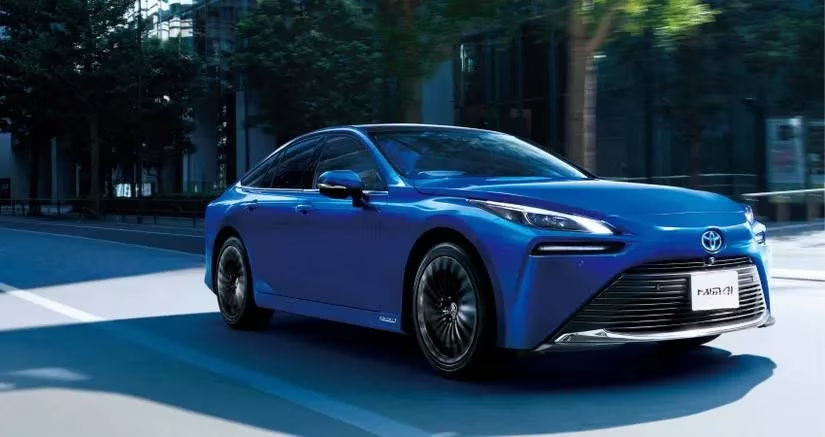
As I drive my electric blue Mirai through the city in 2026, I am a moving question. The future for vehicles like mine is one of hopeful uncertainty. It is a future that hinges on overcoming those costly hurdles—building a continent-spanning web of green hydrogen production and refueling infrastructure. The technology itself is a masterpiece, offering range, speed, and purity that are compelling answers to the lingering questions about our electric future.
Comparison: Hydrogen FCEV vs. Battery EV (circa 2026)
| Feature | Hydrogen FCEV (e.g., Toyota Mirai) | Battery EV (Typical) |
|---|---|---|
| Refueling/Recharge Time | ~5 minutes | 30 minutes to 12+ hours ⚡ |
| Typical Range | 400+ miles | 250-350 miles 🚗 |
| Direct Emissions | Water Vapor only 💧 | Zero at tailpipe 🌿 |
| Energy Source | Compressed Hydrogen | Grid Electricity 🔌 |
| Infrastructure | Sparse, specialized stations | Widespread, growing network 🌍 |
| Vehicle Cost (Operational) | Higher fuel cost per mile | Lower "fuel" cost per mile 💰 |
In the end, my Mirai is more than a car. It is a statement, a belief in a diversified and resilient sustainable future. It is the whisper of hydrogen, asking if we have placed all our bets on one solution. The road ahead is long, and the path is narrow, but as long as the whisper remains—clean, swift, and far-reaching—the journey, for me, is worth every silent mile.

Leave a Comment